

Hoodie Weight Guide: GSM, Oz, and What Actually Matters
Most adult hoodies fall between 7.8 and 12 oz (264 to 407 GSM), with midweight hoodies clustering around 8.8 oz, or roughly 298 GSM. For layering under a jacket or moving through a workout, pick lightweight (7.0 to 8.0 oz / 237 to 271 GSM). For everyday merch that needs to sell year round, midweight (about 8.8 oz / 298 GSM) is the industry default. For streetwear that stands on its own as an outer layer, go heavyweight (10 to 12+ oz / 340 to 407+ GSM).
Quick math: 1 oz/yd² equals roughly 33.906 GSM, so an 8.8 oz fabric lands near 298 GSM. Keep that conversion in your back pocket. Suppliers quote in both units depending on where they manufacture, and half the confusion buyers run into is just unit mismatch, not an actual weight difference.
Key Takeaways
The right hoodie weight depends on GSM matched to use-case: lightweight (240 to 280 GSM) for layering, midweight (280 to 340 GSM) for year-round wear, and heavyweight (340 to 450+ GSM) for standalone streetwear.
| Point | Details |
|---|---|
| Know your bands | Lightweight runs 240 to 280 GSM, midweight 280 to 340 GSM, heavyweight 340 to 450+ GSM. |
| Convert with confidence | The conversion between ounces per square yard and grams per square meter is fixed: 1 oz/yd² equals about 33.906 GSM. |
| Finished weight beats fabric GSM | Zippers, embroidery, and lining can add 2 to 10 oz beyond the raw fabric weight. |
| Fabric drives cost | Fabric commonly makes up 40 to 55% of unit cost, so heavier GSM squeezes margin unless pricing adjusts. |
| Choose heavyweight for structure | Elitebloodlines builds its core and limited-run drops above 340 GSM for a silhouette that holds up over repeated washes. |
Table of Contents
- Hoodie Weight Guide Basics: Lightweight, Midweight, Heavyweight
- What Changes a Hoodie’s Actual Finished Weight
- How Much Does a Hoodie Weigh by Size?
- How Hoodie Weight Shapes Buying, Selling, and Shipping
- How to Pick the Right Hoodie Weight for Your Project
- GSM vs Oz: The Conversion Reference You’ll Actually Use
- Why Elitebloodlines Builds Around Specific GSM Ranges
- The GSM Number That Actually Matters Most
- Get Heavyweight Fabric Built for the Long Haul
- Sources
Hoodie Weight Guide Basics: Lightweight, Midweight, Heavyweight
The three weight classes aren’t marketing labels. They’re numeric bands that predict how a hoodie drapes, breathes, and holds up in the wash.
Lightweight hoodies run 240 to 280 GSM, or about 7.0 to 8.0 oz. These are usually built from a lighter cotton/poly blend or a brushed french terry with minimal fleece backing. They breathe well, pack down small, and work under a jacket without adding bulk. The tradeoff is durability. Thinner fabric pills faster and shows wear at stress points like cuffs and pocket seams within a season or two of regular use.
Midweight hoodies sit at 280 to 340 GSM, roughly 8 to 10 oz, with an 8.5 to 8.8 oz sweatshirt widely classified as the industry-standard midweight for balancing cost, durability, and sell-through across seasons. Most fleece-back cotton/poly blends in this range hold their shape after repeated washing without feeling stiff. This is where most mainstream apparel brands park their core hoodie SKU, because it works in fall, spring, and mild winter without needing a second product line.
Heavyweight hoodies start around 340 GSM and climb past 450+ GSM, translating to roughly 10 to 12+ oz. Industry sourcing guides group these bands around thick, brushed fleece or heavy french terry, often with a tighter loop structure that holds a print or embroidery without stretching out. Here’s the tradeoff breakdown:
- Lightweight (240 to 280 GSM): best for layering and warm climates, weaker at resisting pilling over time.
- Midweight (280 to 340 GSM): the safest year-round bet, standard for most merch and retail drops.
- Heavyweight (340 to 450+ GSM): built to stand alone as an outer layer, commands a higher price point, but costs more to ship and produce.
Elitebloodlines runs heavyweight fabric across most of its core streetwear drops for a reason: the fabric holds structure, resists sagging in oversized cuts, and reads as premium the moment someone touches it. Lighter fabrics can’t fake that.
What Changes a Hoodie’s Actual Finished Weight
GSM measures the fabric itself, not the hoodie you’re holding. Finished-garment weight always runs higher, because it includes ribbing, drawstrings, hardware, thread, and any lining. A hoodie with approximately 300 GSM fabric weight will weigh more once assembled due to additional components like pockets and drawstrings. That delta trips up a lot of first-time sellers pricing shipping off spec sheets alone.
Several factors stack on top of raw fabric weight:
- Fiber content and brushing: a heavily brushed cotton fleece traps more mass per square inch than a smooth poly blend at the same GSM.
- Lining and hood construction: double-layer hoods and lined pockets add fabric that doesn’t show up in a single-ply GSM number.
- Hardware and trims: metal zippers, eyelets, and drawstring tips add ounces that spec sheets often skip entirely.
- Stitch density: flatlock and overlock seams use more thread than a basic single-needle seam, which adds up across a whole garment.
- Size and cut: an oversized XXL cut uses noticeably more fabric yardage than a fitted small, even when both are cut from the same 300 GSM roll.
GSM alone doesn’t fully determine feel, because finish and knit structure change hand and drape even between two fabrics rated at the same number. Two 320 GSM hoodies from different mills can feel like different products entirely.
Pro Tip: Ask any supplier for a finished-garment weight on a mid-size sample, not just the raw fabric GSM. That single number tells you more about shipping cost and perceived quality than any spec sheet line item.
How Much Does a Hoodie Weigh by Size?
Fabric consumption scales with garment size, so a small and an XXL cut from the identical roll can differ by several ounces once you account for extra yardage in the body, sleeves, and hood.
Using blank-supplier style benchmarks, here’s how finished weight tends to break down for a midweight (8.8 oz) and heavyweight (12 oz) hoodie:
| Size | Midweight (~8.8 oz fabric) | Heavyweight (~12 oz fabric) |
|---|---|---|
| Small | ~1.0 lb | ~1.3 lb |
| Medium | ~1.1 lb | ~1.4 lb |
| Large | ~1.2 lb | ~1.5 lb |
| XL | ~1.3 lb | ~1.7 lb |
| XXL | ~1.4 lb | ~1.8 lb |
These are approximate estimates built from blank-supplier style charts that list product weights by oz and GSM, not exact figures for every mill or cut.
Add-ons push those numbers higher. A full metal zipper typically adds 2 to 4 oz. Heavy embroidery adds another 1 to 3 oz depending on stitch density. A double-layer hood construction can tack on 1 to 3 oz more, since these features carry measurable weight beyond the base fabric. Stack a zipper and heavy embroidery on the same heavyweight XXL, and you’re looking at a garment pushing past 2 pounds before it hits a poly mailer.
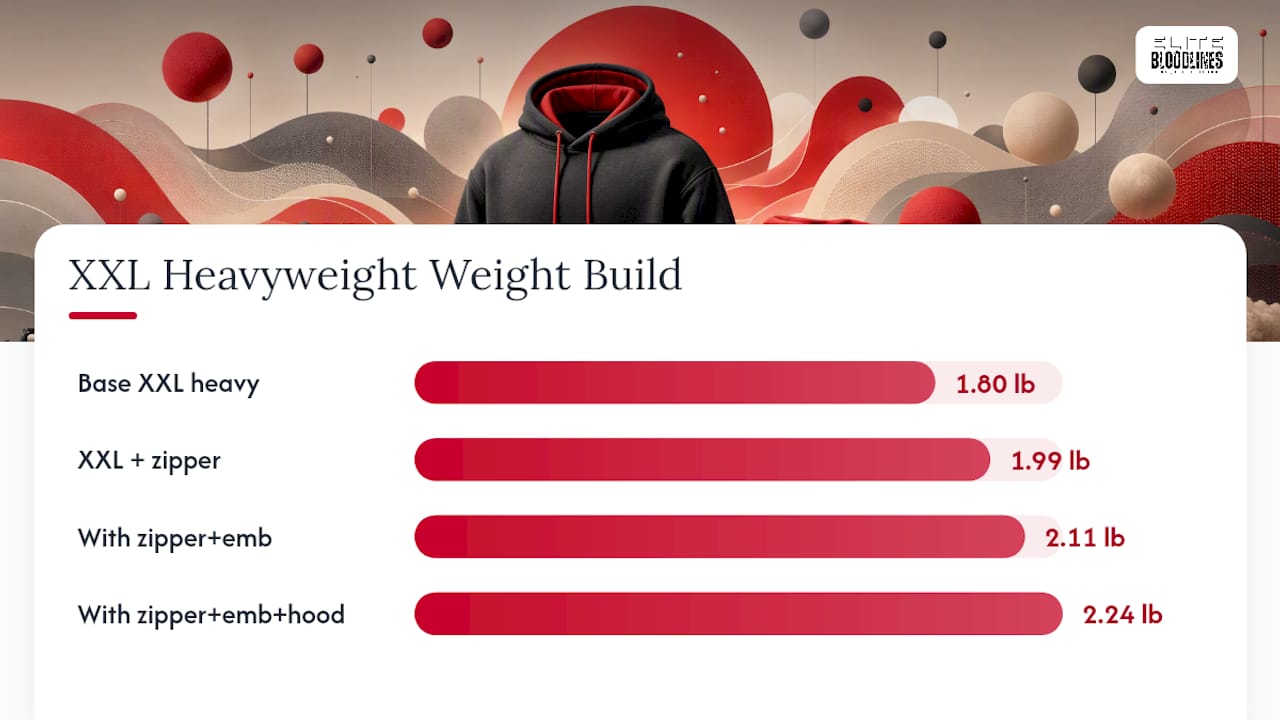
If you’re pricing your own line, weigh one finished sample on a kitchen scale, note the size, then scale proportionally using the size chart above. It’s faster and more accurate than trusting a generic spec sheet from a supplier catalog.
How Hoodie Weight Shapes Buying, Selling, and Shipping
Weight isn’t just a comfort spec. It touches every dollar in your supply chain, from the fabric roll to the customer’s doorstep.
- Shipping cost brackets shift fast. A single heavyweight XXL hoodie with a zipper can cross a carrier’s weight threshold that a lightweight small never comes close to, bumping you into a pricier shipping tier. Build your packaging choice (poly mailer vs. padded box) around your heaviest SKU, not your lightest.
- Fabric cost eats a bigger share of your margin as GSM climbs. Fabric commonly runs 40 to 55% of unit cost, and heavier fabric means more yardage per garment. A jump from 280 GSM to 400 GSM can meaningfully compress margin unless your retail price moves with it.
- Customers judge quality by weight the second they open the package. A hoodie that feels thin for its price point drives return requests, even when the print and stitching are flawless. A hoodie that feels substantial builds trust before the customer even tries it on, which is exactly why Elitebloodlines leans heavyweight on its flagship drops rather than chasing the lowest fabric cost.
Get the weight bracket wrong in either direction and you’re either overpaying on shipping for a product that doesn’t feel premium, or underpricing a heavyweight piece that costs more to make than your margin assumed.
How to Pick the Right Hoodie Weight for Your Project
Whether you’re buying one hoodie for winter layering or sourcing a hundred units for a merch drop, the decision process is the same four steps.
- Define the use-case first. Layering and gym wear point toward lightweight. Everyday retail or year-round merch points toward midweight. Standalone streetwear or cold-climate outerwear points toward heavyweight.
- Pick your GSM band based on that use-case, using the ranges above as your target, not a rough guess.
- Verify fiber content and finish, since a 300 GSM poly blend and a 300 GSM brushed cotton fleece will not feel or perform the same on press or embroidery.
- Request swatches and a finished sample before committing to a bulk order. No spec sheet substitutes for holding the actual fabric.
When you’re vetting a supplier, ask directly: What’s the GSM? What’s the fiber percentage? What’s the pre-wash shrinkage rate? What’s the weight tolerance, typically plus or minus 5%? A supplier who can’t answer those four questions on request is a red flag, and so is a price that seems too low for the GSM they claim to offer.
Pro Tip: If a supplier quotes a heavyweight price but can’t produce a finished-garment weight on request, assume the GSM number is aspirational, not measured.
GSM vs Oz: The Conversion Reference You’ll Actually Use
GSM (grams per square meter) and oz/yd² measure the same thing in different units, and the conversion is fixed: 1 oz/yd² equals approximately 33.906 GSM. Higher GSM generally means heavier, warmer, and more durable fabric, though finish and knit structure still change how it drapes even at an identical number.
| Oz/yd² | Approx. GSM | Typical class |
|---|---|---|
| 7.0 | 237 | Lightweight |
| 8.0 | 271 | Lightweight/Mid border |
| 8.8 | 298 | Midweight |
| 10 | 340 | Mid/Heavy border |
| 12 | 407 | Heavyweight |
Manufacturers typically publish a tolerance of plus or minus 5% on GSM, which is exactly why two hoodies labeled the same weight can still feel different in hand. When measuring fabric yourself, cut a full square meter (or use a certified GSM disc cutter) and weigh it on a gram scale rather than eyeballing a swatch.
Why Elitebloodlines Builds Around Specific GSM Ranges
Michael leads sourcing decisions at Elitebloodlines, drawing on years spent evaluating fleece mills and blank suppliers for streetwear and gym apparel production.
Elitebloodlines targets heavyweight fabric, generally north of 340 GSM, for its core and limited-run drops. That range is recommended by suppliers as a proven balance for brands that need embroidery and print performance without the fabric collapsing under an oversized cut. Customer feedback on the oversized fleeced hoodie consistently points to how the garment holds its silhouette wash after wash, something a lighter fabric can’t deliver.

Testing new fabric lots always starts the same way: weigh a finished sample, check the hand feel after a wash cycle, then compare it against the heavyweight review benchmarks already in rotation. Skipping that step is how brands end up with a “premium” hoodie that thins out after three washes.
The GSM Number That Actually Matters Most
Most buying guides treat GSM like a single dial you turn up for quality. That’s the part conventional advice gets wrong. A 400 GSM hoodie with sloppy brushing and a loose knit can feel cheaper than a well-made 300 GSM piece, because fiber quality and finish do as much work as the raw number.
What the numbers in this guide actually support is narrower and more useful: know your use-case first, pick a GSM band that matches it, then verify fiber content and finished-garment weight before you trust the spec sheet. Skip straight to the highest GSM you can find and you’ll overpay for warmth you didn’t need, or underestimate shipping costs on a bulk order.
If you’re buying one hoodie, weight tells you how it’ll wear over years, not just how it feels on day one. If you’re sourcing a hundred, it tells you your entire margin structure. Treat the GSM number as a starting question, not a final answer, and check the fabric behind it every time.
— Michael
Get Heavyweight Fabric Built for the Long Haul
Elitebloodlines skips the lightweight, cost-cutting fabric that thins out after a few washes. Every core and limited-run drop runs heavyweight, generally above 340 GSM, so the silhouette holds and the print doesn’t crack early.
If this guide left you wanting a hoodie that actually matches the numbers instead of a vague “premium” label, the Current Drops page is where the newest heavyweight releases land first, often in limited quantities. For a classic-fit option built on the same sourcing standards, check the EB Heritage Collection V1. Browse either page now and pick the fit and weight that actually match your use-case, not just the price tag.
Sources
For deeper technical detail, consult the Printful hoodie weight breakdown for midweight standards, the Fexwear GSM sourcing guide for weight bands and tolerances, the Three Layer fabric weight chart for style-specific examples, and the Ready One GSM fabric guide for cost-share data.
- How Much Does a Hoodie Weigh? - Printful blog
- GSM Hoodie Meaning: A Sourcing Guide for Brands & Buyers - Fexwear
- Blank Hoodie Fabric Weight Chart: Oz and GSM by Style - Three Layer
- Best Fabric for Custom Hoodies: GSM Guide | Ready One