

Copy These Men's Streetwear Outfits Instead of Overthinking It
Copy five tested outfit formulas, each built around one statement piece and clean sneakers, and you have modern streetwear looks without guesswork. That is the whole system. One bold item carries the outfit; everything else stays quiet and lets it work.
Start here:
- Oversized hoodie + tapered cargo pants + low-top sneaker
- Heavyweight graphic tee + straight denim + bomber jacket
- Monochrome black on black, textures providing the contrast
- Tank + jogger + high-top for gym-to-street days
- Cream tee + relaxed jeans + classic three-stripe sneaker
Build your rotation on the 3-3-3 capsule method and lean toward heavier fabrics. That combination is what separates a wardrobe that looks put-together from one that just looks busy.
Key Takeaways
Modern men’s streetwear outfits work when one statement piece anchors the look and every other item stays neutral, heavyweight, and correctly proportioned.
| Point | Details |
|---|---|
| One statement rule | Pick a single bold sneaker, jacket, or graphic tee per outfit and keep everything else neutral. |
| Fabric weight matters | Look for 200 to 240 GSM tees and 400+ GSM hoodies for better drape and durability. |
| Use the 3-3-3 capsule | Nine coordinated pieces (3 tops, 3 bottoms, 3 shoes) create 27 wearable combinations. |
| Balance proportions | Pair one oversized layer with tapered or structured bottoms to avoid a sloppy silhouette. |
| Build around Elitebloodlines basics | EB Graphic Tees and the Heritage Collection supply the heavyweight statement pieces these formulas are built on. |
Table of Contents
- Men’s Streetwear Outfits: 10 Formulas You Can Copy Today
- Essential Pieces: The Closet Building Blocks For Modern Streetwear
- The 3-3-3 Rule: A Compact Capsule That Actually Works
- Fit, Fabric Weight, and Proportions: What Actually Holds Up
- Seasonal Tweaks: Making These Formulas Work Year-Round
- Practical Pro Tips and Mistakes That Kill an Outfit
- Accessories and Their Role in Men’s Streetwear
- Color Coordination and Pattern Mixing in Streetwear
- Where Men’s Streetwear Style Actually Comes From
- How to Wear Logos and Graphic Prints Without Overdoing It
- Layering Beyond the Basics
- Adapting Streetwear for Semi-Formal and Casual Settings
- The Streetwear Rule Nobody Follows Enough
- Shop the Looks: Where Elitebloodlines Fits In
- Sources
Men’s Streetwear Outfits: 10 Formulas You Can Copy Today
Every formula below follows the same math: pick your one loud piece, then mute the rest. Here are ten men streetwear looks that photograph well and hold up in real life.
1. The everyday uniform. Heavyweight tee, straight jeans, low-top sneaker, and a bomber tied around the waist or worn open. Why it works: nothing competes for attention, so the tee’s graphic gets to be the whole story.
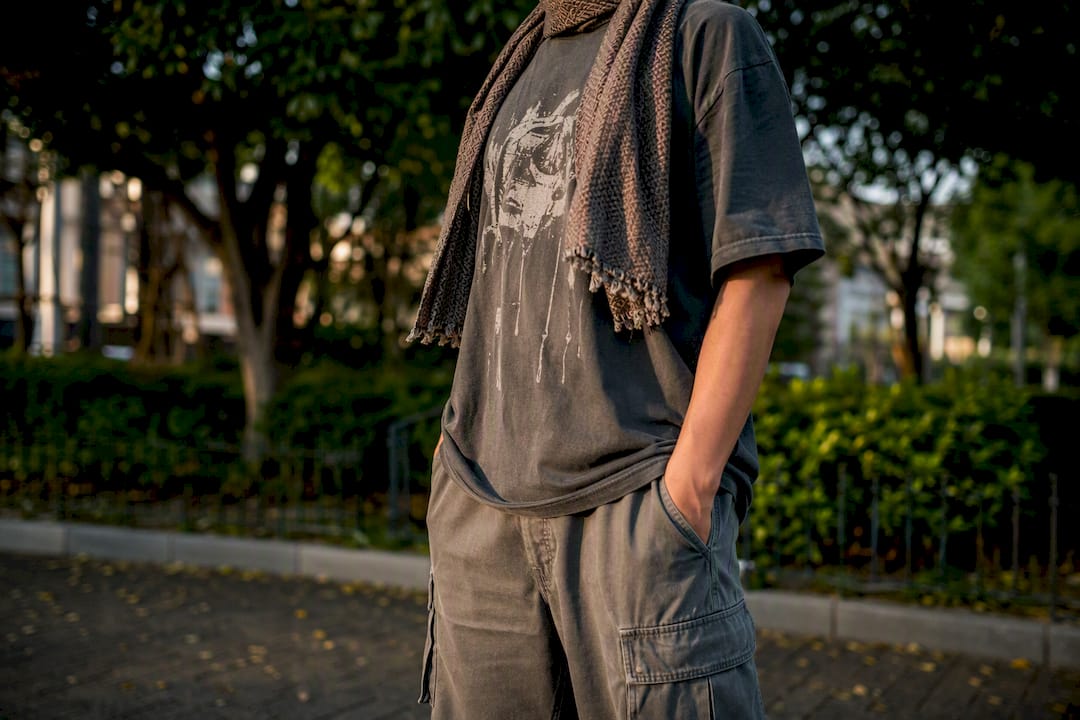
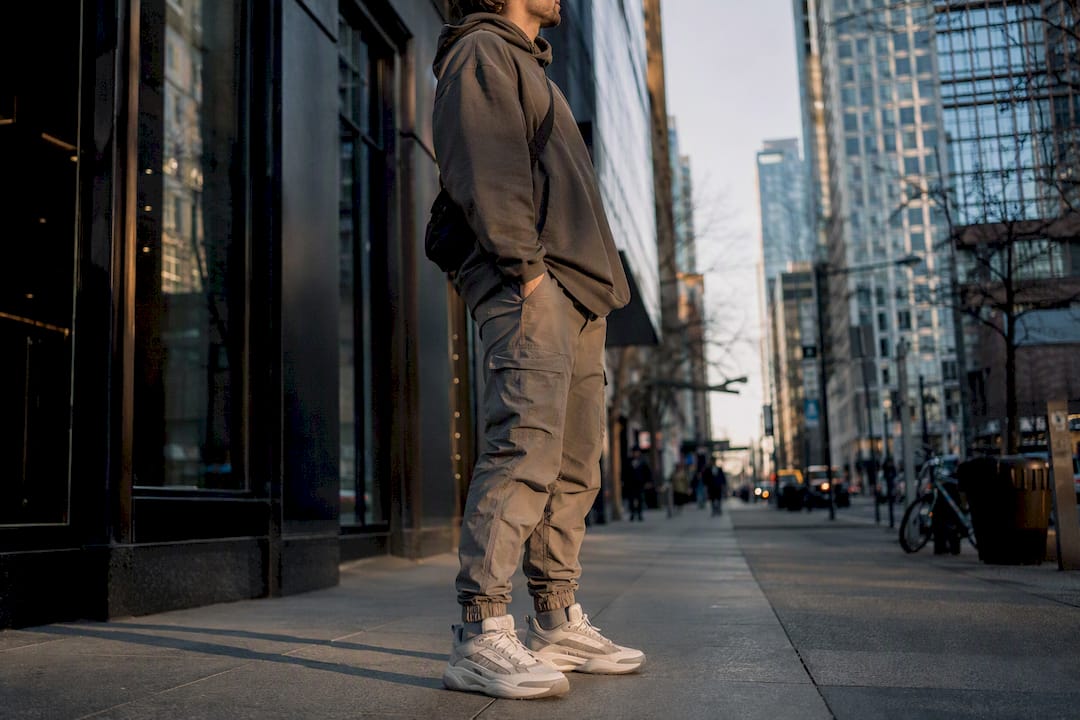
2. Hoodie and cargo stack. Oversized hoodie, tapered cargo pants, chunky sneaker, crossbody bag. The taper on the pants keeps the hoodie from swallowing your frame.
3. Monochrome black. Black tee, black joggers, black sneaker, varied textures (fleece, nylon, leather). One color, three fabrics, zero effort.
4. Athleisure crossover. Tank top, mesh shorts or joggers, high-top sneaker, bucket hat. Built for gym-to-street days when you don’t want to change clothes twice.
5. Denim-on-denim. Denim trucker jacket, graphic tee, straight jeans in a slightly different wash, white sneaker. Two washes of denim read intentional, not accidental.
6. Summer statement. Boxy tee, cargo shorts, breathable low-top, bucket hat as the accent. Lighter fabrics but the same one-statement-piece rule applies.
7. Elevated streetwear. Structured overshirt, slim tee, tapered trouser, minimal sneaker. This is the “smart casual” version for readers heading somewhere with a dress code buffer.
8. Cream and relaxed. Cream heavyweight tee, relaxed jeans, Samba OG or similar low-top. Neutral palette, one texture shift at the shoe.
9. Layered cold-weather look. Hoodie under a coach jacket, straight jeans, boot-style sneaker. Three layers max, and the jacket is the statement.
10. Bold sneaker anchor. Plain tee, plain joggers, one loud colorway sneaker. The shoe is doing all the work, so nothing else should argue with it.
Pro Tip: Pick which piece is your statement before you get dressed, not after. If you’re building the outfit around the sneaker, decide that first, then choose neutral everything else. Reverse the order and you’ll end up with three things competing for attention.
Essential Pieces: The Closet Building Blocks For Modern Streetwear
Every formula above draws from the same short list of pieces. Own these and you can mix them into more outfit combinations than you’d expect.
- Heavyweight tees (200 to 240 GSM): heavier cotton holds its shape wash after wash and drapes better than a thin retail tee.
- Hoodies at 400+ GSM: this is where oversized fits actually look intentional instead of sloppy. Thin hoodies collapse; heavy ones hold structure.
- Relaxed or straight jeans: the workhorse bottom that pairs with almost every top on this list.
- Cargo trousers: tapered at the ankle, roomy through the thigh. This is your utility piece for the hoodie-and-cargo formula.
- Clean low-top sneakers: one pair in white or off-white does more outfit-building work than three flashy pairs.
- A bomber or coach jacket: start with a neutral jacket if you’re buying outerwear for the first time. It’s forgiving and works across seasons.
- A crossbody bag: small, functional, and it fills the accessory gap without overcomplicating the outfit.
Each piece multiplies what the others can do. Want the full sequence for building this out? Build a Streetwear Capsule Wardrobe: 12-Piece Starter Guide walks through the order to buy in.
The 3-3-3 Rule: A Compact Capsule That Actually Works
Three tops, three bottoms, three pairs of shoes. That’s 27 combinations from nine total pieces, and it forces you to buy pieces that actually coordinate instead of chasing whatever dropped last week.
Here’s a sample capsule:
- Tops: a heavyweight graphic tee, a plain 400+ GSM hoodie, a bomber jacket.
- Bottoms: straight jeans, tapered cargo pants, black joggers.
- Shoes: white low-top, black high-top, one statement colorway.
Pick one neutral palette (black, cream, olive, gray) as your base, then let one piece per outfit carry color or texture. The math does the rest.
Fit, Fabric Weight, and Proportions: What Actually Holds Up
Fabric weight is the detail most guys skip and the one that shows fastest. Tees in the 200 to 240 GSM range resist pilling and keep their shape after repeated washes. Hoodies at 400 GSM or heavier drape properly instead of hanging like a bedsheet.
The proportion rule is simple: one oversized layer per outfit, paired with something tapered or structured. Oversized hoodie, tapered pants. Boxy bomber, slim tee underneath. Break this rule and the whole outfit reads sloppy instead of intentional.
Elitebloodlines builds around this exact standard:
- Heavyweight graphic tees designed for drape and durability, not just a print on thin cotton
- Oversized and classic fits engineered to pair correctly with structured bottoms
- Limited-run drops that keep the “one statement piece” philosophy built into the product itself
Seasonal Tweaks: Making These Formulas Work Year-Round
The same formulas carry through summer and winter with a few swaps.
Warm weather:
- Swap cargo pants for cargo shorts or lightweight straight-leg pants
- Trade the hoodie for a lighter, shorter-sleeve layer
- Go with breathable low-top sneakers instead of anything insulated
Cold weather:
- Add a puffer or shearling jacket as your outer layer
- Layer a heavyweight hoodie underneath for warmth without bulk
- Switch to boots or a sturdier high-top sneaker
Cap it at three layers regardless of season, and vary the textures between them (fleece against nylon against denim) so the outfit doesn’t read flat.
Practical Pro Tips and Mistakes That Kill an Outfit
Pro Tip: Skip the hype piece and buy the staple instead. A 400 GSM hoodie you’ll wear fifty times beats a limited sneaker you’ll wear five. If your sneaker is loud, keep everything else quiet; if your jacket is the statement, let the shoe be plain. And if a hoodie fits big everywhere but the sleeves, a simple hem fixes the proportion instantly.
Accessories and Their Role in Men’s Streetwear
A hat, a chain, and a bag do more outfit-building work than most guys give them credit for, but they follow the same one-statement rule as everything else.
Hats are the easiest entry point. A bucket hat or a fitted cap adds texture without adding color, which makes it safe to pair with almost any of the ten formulas above. Stick to one hat per outfit and keep it in your existing palette rather than introducing a new color.
Chains work best as a quiet detail rather than the loudest thing in the outfit. A simple chain layered under a heavyweight tee reads intentional. Three chains stacked with a graphic tee, a bold sneaker, and a printed jacket starts competing with itself.
Bags solve a real problem: streetwear silhouettes don’t always have functional pockets, and a crossbody or sling bag fills that gap without breaking the line of the outfit. Choose one in a neutral tone (black, olive, tan) so it slots into any capsule without becoming its own statement piece.
The rule across all three: accessories support the outfit’s one statement piece. They don’t replace it, and they definitely shouldn’t compete with it. A loud chain, a loud hat, and a loud bag on the same outfit is the fastest way to turn an intentional look into a cluttered one.
Color Coordination and Pattern Mixing in Streetwear
Limit yourself to one strong color moment per outfit. That’s the single rule that keeps streetwear looking clean instead of chaotic, and it applies whether the “moment” is a sneaker, a jacket, or a graphic print.
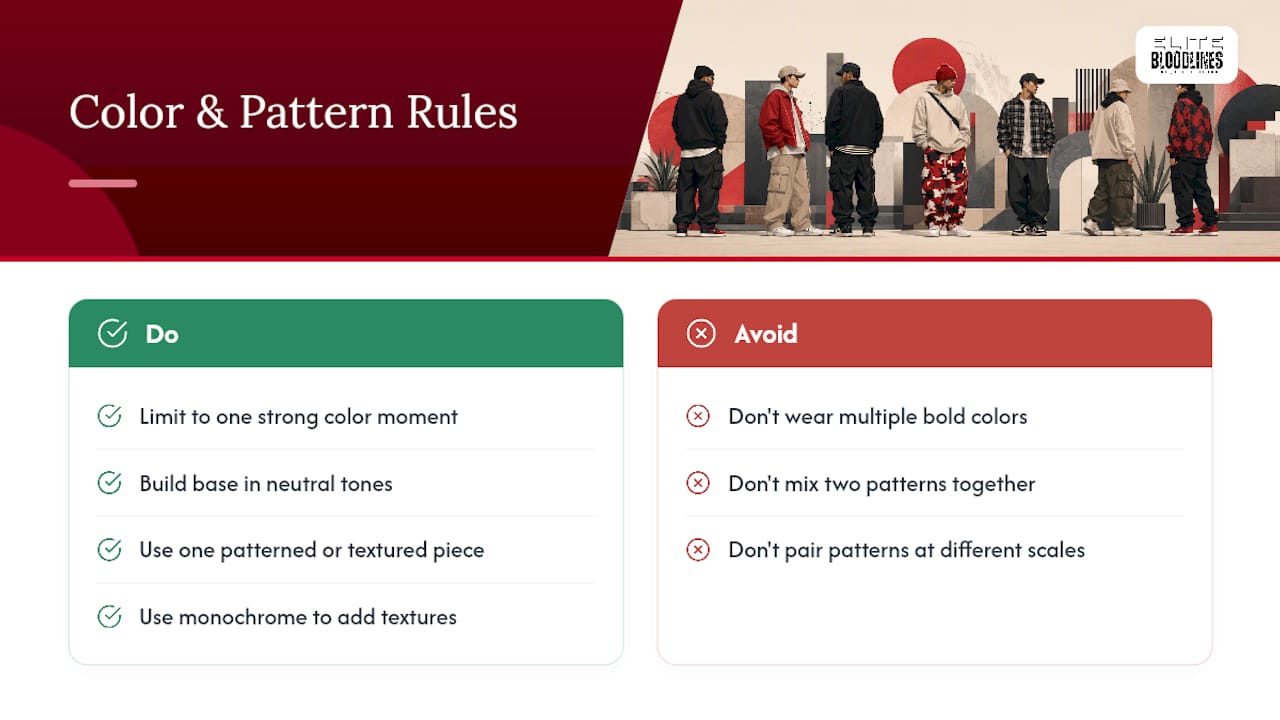
Build your base in those tones, then introduce one bold color through a single piece. A red sneaker with black joggers and a gray tee works. A red sneaker, a green jacket, and a yellow tee does not.
Pattern mixing follows a similar restraint. If you’re wearing a graphic tee with a busy print, keep the bottoms and outerwear solid. If you’re mixing textures instead of colors (a plaid overshirt over a plain tee, for instance), that counts as your one pattern moment for the outfit. Two patterns in the same look, especially at different scales, tend to fight for attention rather than complement each other.
The exception is monochrome dressing. When everything sits in the same color family, you can afford more texture and even subtle pattern variation because the color consistency holds the outfit together. That’s part of why all-black looks are so forgiving. It’s the one setup where breaking the “one statement” rule doesn’t actually create visual noise.
Where Men’s Streetwear Style Actually Comes From
Modern streetwear didn’t start on a runway. It came out of 1970s and 1980s skate culture in California, where function dictated form: baggy fits for movement, durable fabrics for pavement, and graphic tees that doubled as brand identity for skate crews and shops.
Hip-hop culture in New York and later the West Coast pulled from that same DNA and added its own signatures: oversized silhouettes, bold logos, and sneaker culture as a status marker. Both scenes shared a core value that still defines the category: clothing as identity, not just clothing as utility.
Japanese streetwear brands in the 1990s added a layer of craftsmanship and exclusivity, limited runs, premium fabrics, cult followings, that pushed the category upmarket without losing its rebellious edge. That’s the lineage behind why limited-run drops and heavyweight construction carry more weight in streetwear than in ordinary casualwear. The scarcity and the quality aren’t marketing gimmicks; they’re inherited from decades of subculture that valued both.
What’s shifted heading into 2026 is volume versus intention. Early streetwear leaned on maximalism, logos everywhere, loud graphics stacked on loud graphics. The current direction favors quieter branding and heavier fabrics, which is really the same skate and hip-hop values (authenticity, durability, identity) expressed with more restraint.
How to Wear Logos and Graphic Prints Without Overdoing It
One graphic piece per outfit is the rule that keeps a logo-heavy wardrobe from reading as a walking advertisement. If your tee has a bold front print, let the rest of the outfit go plain: solid pants, a clean sneaker, no competing text or logos on the jacket.
Placement matters more than most guys think. A large chest graphic reads as the outfit’s statement piece automatically, which means it needs the same neutral support system as a bold sneaker or jacket would. A small logo on the chest or sleeve, by contrast, functions more like an accessory. You can pair it with slightly more texture elsewhere because it’s not asking for the same attention.
Scale and placement together decide whether a print reads as intentional or cluttered. A faded, oversized graphic on heavyweight cotton looks deliberate because the fabric and print work together. The same graphic on a thin, boxy tee can look cheap even if the design itself is identical. This is part of why fabric weight and graphic design get discussed together in serious streetwear guides. The print is only half the equation.
If you’re building a wardrobe around graphic tees specifically, treat them as your rotating statement piece and keep every other layer, hoodie, jacket, pants, sneaker, in solid neutral tones. That’s the formula that lets you own ten graphic tees without ever looking like you’re wearing ten competing outfits.
Layering Beyond the Basics
Most guys stop at “tee plus jacket.” The move that actually changes how an outfit reads is putting a hoodie underneath something structured, a bomber, a coach jacket, an overshirt, so the hood and cuffs peek out at the collar and wrists.
This does two things. First, it adds a visible texture layer without adding bulk, since the jacket contains the hoodie’s volume. Second, it lets you wear heavier hoodies in transitional weather without overheating, because the outer layer can come off while the hoodie still reads as a complete look on its own.
The three-layer maximum still applies here: tee, hoodie, jacket is the ceiling. Push past that and you start losing the silhouette clarity that makes streetwear look sharp instead of bulky. Vary the textures between layers too. Cotton tee, fleece hoodie, nylon jacket gives you three different surfaces that read as intentional layering rather than three shirts stacked for warmth.
One more layering trick worth knowing: unzip the outer layer partway to show the hoodie’s graphic or logo underneath. That turns a hidden piece into a visible detail without adding a fourth layer, and it’s how a lot of the cleanest layered looks actually get built.
Adapting Streetwear for Semi-Formal and Casual Settings
Streetwear doesn’t have to stay in one gear. The same pieces flex up or down depending on cut and fabric choice.
For fully casual settings, oversized fits and bold graphics are fair game: the hoodie-and-cargo stack, the monochrome black look, the athleisure crossover. These work for hanging out, running errands, or a casual weekend event where comfort matters more than polish.
For settings that call for slightly more effort (a dinner, a date, a casual office), swap the oversized hoodie for a structured overshirt or a slim-fit heavyweight tee under a clean jacket. Trade joggers for tapered trousers or dark straight jeans, and swap the chunky sneaker for a minimal low-top in white or black. The graphic elements should shrink too: a small logo instead of a full chest print keeps the look from feeling too casual for the room.
The underlying formulas don’t change. You’re still choosing one statement piece and muting everything else. What changes is which piece gets to be loud. In casual settings, that can be a bold sneaker or a printed tee. In semi-formal settings, the “statement” often becomes something quieter, a well-cut jacket, a clean color choice, rather than a graphic or a flashy shoe. The one-statement-piece discipline is what makes streetwear scale across settings in the first place.
The Streetwear Rule Nobody Follows Enough
Everyone wants more clothes. Almost nobody wants fewer, better choices. That’s the gap I keep coming back to when I look at how most guys actually build a streetwear rotation: closets full of one-off pieces that don’t talk to each other, and no system tying it together.
The 3-3-3 approach isn’t a gimmick, it’s math that forces discipline. Nine pieces, chosen to coordinate, produce more usable outfits than thirty pieces bought at random. That’s the part conventional streetwear content skips over in favor of showing you the newest drop. Elitebloodlines builds toward that same discipline: heavyweight basics designed to be the reliable core of a rotation, not a one-time impulse buy that sits in the closet after two wears. If you want deeper reading on how the capsule math plays out, the oversized tee guide is a good next stop.
Shop the Looks: Where Elitebloodlines Fits In
Elitebloodlines is built for the exact formulas covered above. Every outfit here leans on one heavyweight statement piece surrounded by neutral basics, and that’s precisely what the EB Graphic Tees collection delivers: heavyweight cotton, bold retro-inspired prints, and fits designed to pair correctly with tapered bottoms instead of fighting your proportions.
If you’re building the 3-3-3 capsule from scratch, the EB Heritage Collection V1 gives you a classic-fit hoodie and tee option to anchor your neutral base, while Current Drops rotates in limited-run statement pieces for whichever outfit needs the loud element that week. Every piece is made in limited runs, so the tee carrying your outfit’s statement won’t show up on the next five guys you pass on the street.
Start by picking one graphic tee that fits your palette, then build the rest of your capsule around it. Shop the EB Graphic Tees collection now and put one of these formulas together tonight.
Sources
- Streetwear Outfit Ideas for Men: NYC Style Guide (2026)
- Men’s Streetwear Outfits 2026: Trends, Outerwear & Styling Guide
- How Can Men Wear Streetwear Without Looking Messy? 15 Men’s Streetwear Outfits That Look Cool And Clean - AuraFashionTips