

The Streetwear Layering Guide That Actually Builds a Look
The simplest streetwear layering system is a fitted base, a volume mid layer (usually a hoodie), and a structured outer. Three rules make it work every time: balance oversized against fitted, vary your fabric weights so nothing suffocates, and cap your palette at 2 to 3 colors plus one accent. Copy this starting formula tonight: fitted tee, hoodie, denim or bomber jacket.
- Base: fitted, close to skin, breathable
- Mid: your volume and personality piece, usually a hoodie
- Outer: finishes the silhouette and handles weather
- Rule of three: one oversized piece max, mixed fabric weights, tight color count
Key Takeaways
The three-layer formula — fitted base, volume mid, structured outer — works reliably only when paired with fabric weight balance and a disciplined color palette.
| Point | Details |
|---|---|
| Master the three layers | Base stays fitted and breathable, mid carries volume, outer finishes the silhouette. |
| Balance oversized with fitted | Keep only one piece oversized at a time to avoid a shapeless outfit. |
| Match fabric weights carefully | Pair heavier mid layers with lighter outer layers to maintain comfort and style. |
| Cap your color palette | Stick to 2 to 3 colors plus one accent, and mix textures instead of adding more color. |
| Plan for weather shifts | Use removable mid layers and water-resistant outers for transit days and rain. |
Table of Contents
- What Do Base, Mid, and Outer Layers Actually Do?
- How Do You Balance Oversized and Fitted Pieces?
- Which Fabric Weights Work Best for Layering?
- How Do You Coordinate Color and Texture in Layers?
- Ready-to-Copy Outfits for Mild, Cool, and Cold Weather
- What Are the Most Common Layering Mistakes?
- How Should You Adjust Layers for Rain, Humidity, or Transit Days?
- How Elite Bloodlines Builds Layer-Ready Pieces
- Bring the Formula Home With Elite Bloodlines
- What the Research Actually Supports About Layering
- Sources
What Do Base, Mid, and Outer Layers Actually Do?
Each layer in the three-layer system has one job, and confusing those jobs is why most layered outfits collapse into a shapeless pile.
- Base layer. Fitted, breathable, and close to the skin. It gives your outfit structure and keeps sweat off your body when the mid and outer go bulky.
- Mid layer. This is your visual anchor: a hoodie or overshirt that adds volume and carries the graphic or color story. It’s doing the most personality work in the fit.
- Outer layer. Finishes the silhouette and handles the elements. A puffer, denim jacket, or bomber should match the vibe you’re going for, not just the temperature.
Two layers work fine on mild days or when you’re moving a lot. Three layers earn their place once temperatures drop or you need real wind and rain protection.
Pro Tip: Try your outfit sitting down before you leave the house. A mid layer that bunches at the waist when seated will bunch all day.
How Do You Balance Oversized and Fitted Pieces?
Bulk happens when every piece is loose at once. For guidance on balancing oversized and fitted looks, check out this women’s styling guide on wearing oversized vintage shirts. The fix is proportion discipline: pick one place to go big and keep everything around it slimmer.
- Keep your base layer or your bottoms fitted if your mid layer is oversized.
- Run the shoulder seam test: an oversized hoodie’s shoulder seam should drop slightly past your actual shoulder, not halfway down your arm.
- Check sleeve finish at the wrist. Sleeves that swallow your hand read as sloppy, not intentional.
- Try the classic recipe: oversized hoodie plus tapered jeans, or a fitted base under an oversized outer.
Taller frames can handle longer hem drops without looking overwhelmed. Shorter frames should shorten the outer layer relative to the mid to avoid visually cutting the leg line.
Pro Tip: If two pieces are both oversized, one of them needs to come off before you leave. This is the fastest fit-check in streetwear.

Which Fabric Weights Work Best for Layering?
Layering fails more often from fabric choice than from style choice. A base layer in cotton, merino, or a technical wicking blend stays light under everything else, while your mid layer is where weight actually matters.
- Light base: cotton, merino, or moisture-wicking technical fabric.
- Mid weight: look for hoodies described by GSM (grams per square meter), a real measurement of fabric density.
- Heavy mid plus heavy outer is the most common failure. Two thick layers stacked together trap heat and restrict movement.
- For transitional weather, swap heavy fleece for loopback French terry. It holds shape without the bulk.
Dense French terry hoodies of a suitably dense fabric hold their shape under outerwear, according to MioLook’s layering guide, while high-synthetic fleece traps moisture and causes overheating faster. That density also keeps a hood’s shape intact instead of collapsing flat under a jacket collar.
How Do You Coordinate Color and Texture in Layers?
Color discipline is what separates a “fit” from a pile of clothes. Start neutral, then add exactly one statement color or graphic and stop there.
- Cap your palette at 2 to 3 main colors across the whole outfit.
- Mix textures deliberately: denim against leather, knit against nylon. Texture contrast adds depth that color alone can’t.
- Layer light to dark as you move outward. It’s not a rule carved in stone, but it reads cleaner in most combos.
- Save bold graphics for your mid layer where they show. If your outer covers most of your torso, let the base stay plain.
Ready-to-Copy Outfits for Mild, Cool, and Cold Weather
You don’t need ten outfits memorized. You need three formulas, one per temperature range, that you can rebuild with whatever’s clean.
- Mild weather: fitted tee, overshirt, light jacket, low-top sneakers. Keep the palette tight since there’s less fabric to hide a mismatch.
- Cool weather: tee, oversized hoodie, denim or bomber jacket, tapered pants, high-tops or boots. This is the classic three-layer hoodie stack, and it’s forgiving on proportion as long as your pants stay slim.
- Cold weather: thermal base, mid-weight hoodie, puffer or wool coat, insulated boots. This is where GSM guidance matters most, since a thin hoodie under a heavy coat leaves gaps in warmth.
Accessories decide whether an outfit looks finished or unfinished. A beanie pulls a cool-weather fit together instantly and covers the one detail people notice first: hair that doesn’t match the effort of the outfit. Scarves work best tucked into a coat rather than draped loose, which avoids adding visual bulk to your neckline. Crossbody bags and structured backpacks add a functional layer of their own, but oversized bags fight with an already-oversized hoodie, so pick a slimmer bag when your mid layer is already doing volume work.
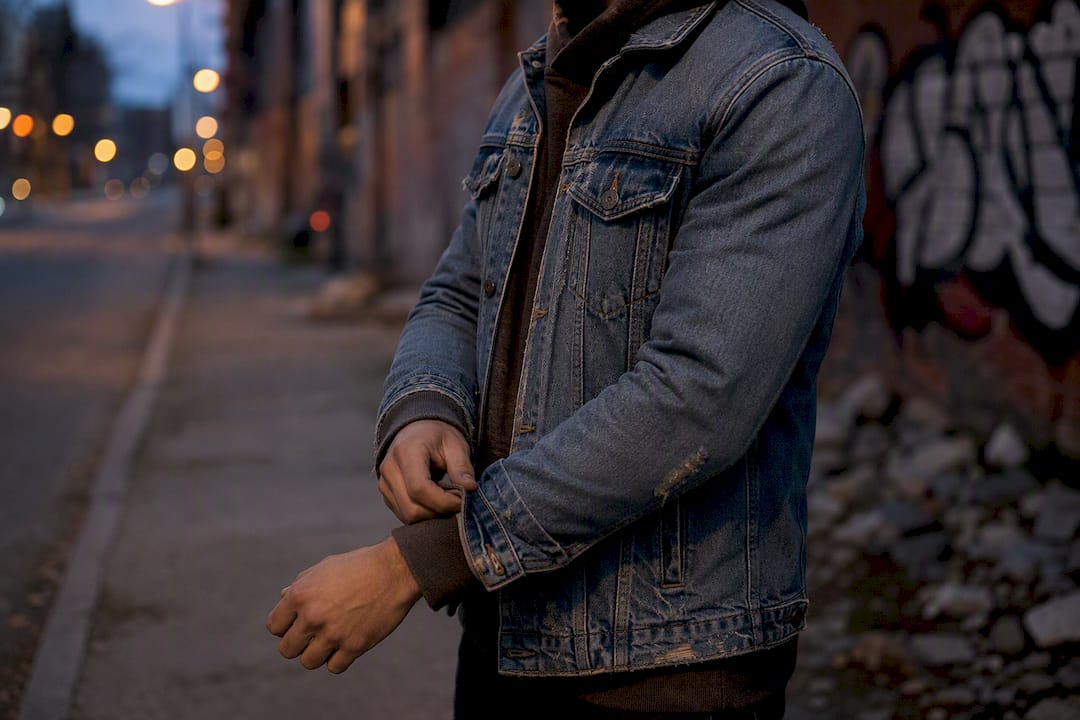
One combination worth calling out directly: a hoodie under a denim jacket or bomber is one of the most reliable pairings in streetwear, and it scales from mild to cold with a fabric swap underneath. For situations that call for a cleaner look, swap the graphic hoodie for a solid one and the bomber for structured outerwear.
What Are the Most Common Layering Mistakes?
Most bad layering comes down to a handful of repeat offenders. Here’s how to spot and fix them fast.
| Mistake | Fast fix |
|---|---|
| Stacking two heavy fabrics | Swap one layer for a lightweight alternative like a cotton tee or thin overshirt |
| Too many colors competing | Simplify to 2 to 3 colors plus one accent piece |
| Multiple oversized pieces at once | Keep one oversized item, tighten everything else |
| Skipping the fitted base | Add a fitted tee or thermal underneath before adding volume |
- Run a 30 second morning check: one oversized piece, fitted base or bottoms, palette under three colors.
- If something feels bulky, remove the outer layer first and reassess. Stacking mistakes are almost always in the mid or outer, not the base.
How Should You Adjust Layers for Rain, Humidity, or Transit Days?
Weather outside your control is where a good system earns its keep. Swap in a water-resistant outer and a quick-dry base for rain or humidity, since cotton holds moisture and stays cold against skin.
On transit-heavy days, hopping between subway platforms and heated offices, a thin base with a removable mid layer prevents the overheating that comes from being stuck indoors in a full three-layer stack.
- Pack a compressible mid layer if you’re traveling. It folds small and unpacks its shape fast.
- Build outfit modularity into your bag: one hoodie can serve three different outfits if your base and outer rotate around it.
Pro Tip: Keep one packable shell in your bag from October through March. It turns any base-and-mid combo into a complete cold-weather outfit in seconds.
How Elite Bloodlines Builds Layer-Ready Pieces
Elite Bloodlines designs its heavyweight tees and hoodies specifically to hold their shape inside a layered stack, not just as a standalone piece on a hanger. That’s the difference between a hoodie that collapses under a jacket and one that keeps its structure all day.
- EB Graphic Tee: a fitted, heavyweight base layer built to anchor the whole outfit.
- Mid-weight EB hoodie: dense enough to hold shape as your mid layer, without stacking bulk on top of a base.
- Structured outer: pairs with the hoodie’s silhouette instead of fighting it for volume.
Every collection runs as a limited release, which means the fit you build today isn’t the fit everyone else is wearing next month. For a full breakdown of building a wardrobe around fewer, more versatile pieces, Elite Bloodlines’ guide to a 12-piece capsule wardrobe walks through exactly which tops and outers to start with.
| Capsule piece | Role in the layer system |
|---|---|
| Heavyweight graphic tee | Fitted base layer, anchors the whole fit |
| Mid-weight hoodie | Volume and personality layer |
| Structured outer | Finishes silhouette, adds weather protection |
Own your look. Trust the layers, trust the build. Own Your DNA starts with the pieces you stack it on.
Bring the Formula Home With Elite Bloodlines
The three-layer system only works as well as the pieces you put into it. A base tee that loses shape after two washes or a hoodie that goes flat under a jacket collar undoes every proportion rule in this guide.
Elite Bloodlines’ EB Graphic Tees are cut heavyweight on purpose, built to anchor a base layer without stretching out by midday. If you’re building a mid layer that actually holds structure, check the Future Drops for the newest limited-run hoodies before they’re gone. Each drop is exclusive by design. No restocks, no dilution, just pieces built for a Bloodline that refuses to blend in.
What the Research Actually Supports About Layering
Most layering advice online obsesses over color theory and Pinterest-perfect combos while skipping the part that actually breaks outfits: fabric weight. You can nail every color rule in this guide and still look bulky if your mid and outer layers are both heavyweight fleece fighting for the same space.
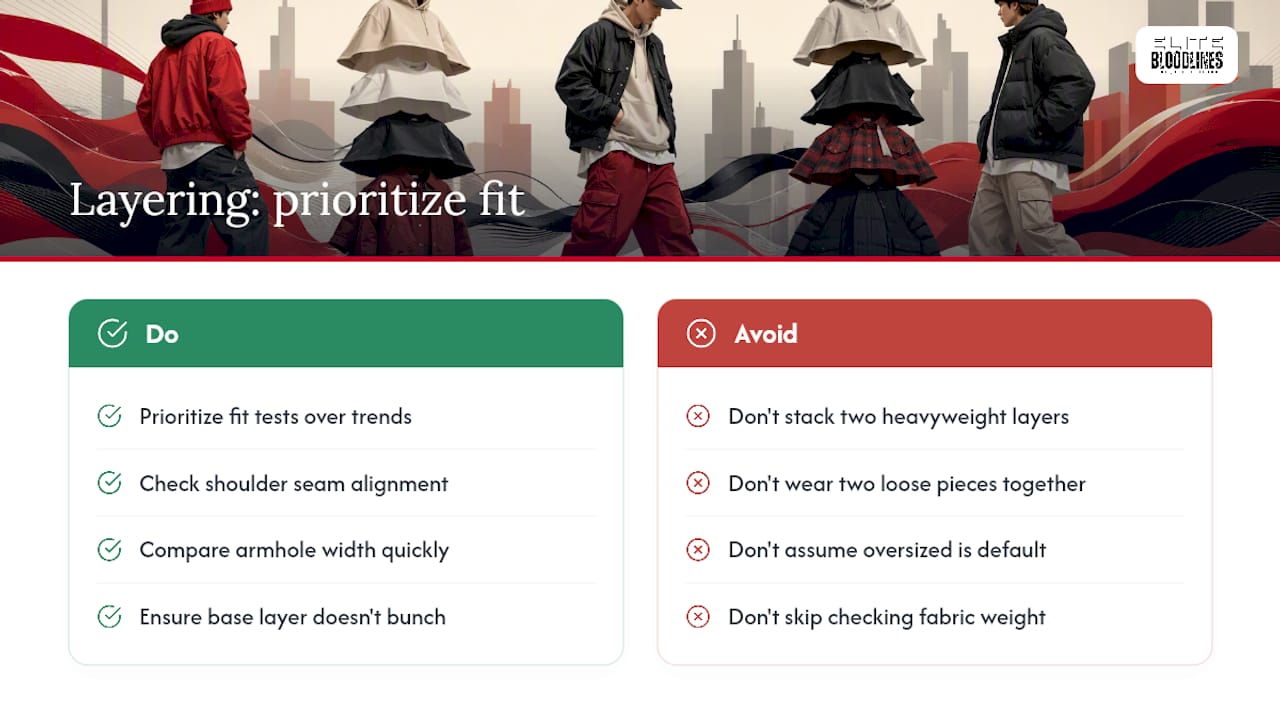
The proportion tests matter more than people give them credit for. A shoulder seam check or an armhole width comparison takes ten seconds and prevents the single most common streetwear mistake: an outfit that looks accidental instead of built. Conventional advice treats oversized fits as a default setting. It isn’t. Oversized only works as a deliberate contrast against something fitted, and the moment you stack two loose pieces, the whole look reads as unfinished rather than intentional.
If you take one thing from this guide, prioritize fit tests over trend chasing. Trends cycle. A hoodie that holds its shape under a jacket, and a base layer that doesn’t bunch, that’s the foundation every good streetwear outfit sits on.
— Michael
Sources
- What to Wear with a Hoodie in Winter: Layering Secrets — MioLook
- Streetwear Layering Tips That Actually Work | BaddieHub Magazine
- 7 Essential Rules to Layer Streetwear Like a Pro 2026
Recommended
- Build a Streetwear Capsule Wardrobe: 12-Piece Starter Guide – Elite Bloodlines Apparel
- How to Style Gym Streetwear Without Looking Basic – Elite Bloodlines Apparel
- Women’s Streetwear Outfits: 8 City-Ready Formulas – Elite Bloodlines Apparel
- Kids Streetwear Outfits That Hit Hard – Elite Bloodlines Apparel