

Small Brands: Run 15–20 Washes Before Picking Garment or Pigment Dye
Garment dye soaks into the fiber itself, bonding at a molecular level for color that stays even and saturated wash after wash. Pigment dye coats the surface with a binder, creating the faded, lived-in look streetwear built its whole aesthetic around. Want consistent color and crisp graphics? Go garment dye. Want instant vintage character? Pigment dye wins.
TL;DR:
- Proper execution of dyeing processes is critical; skipping hot wash-off in garment dyeing can cause dye bleeding, while poor binder quality in pigment dyeing leads to cracking and abrasion.
- Garment dyeing results in a uniform, saturated color that fades gradually, whereas pigment dyeing creates a softer, vintage look with surface abrasion that shows with wear.
- Garment dyeing offers better print detail and color consistency for fine graphics, while pigment dyeing requires careful ink selection to prevent bleeding during printing.
- Heavy-wash, durable items like gym wear are better suited for garment dyeing, while pigment dyeing is favored for lower-cost, vintage-style pieces.
- A brand’s process discipline, including wash-off quality and binder grade, is more important than the dye method when ensuring garment longevity and appearance.
Table of Contents
- Garment Dye vs Pigment Dye: How Each Process Actually Works
- What You’ll See and Feel in Garment-Dyed vs Pigment-Dyed Fabric
- What Production Managers Need to Know Before Committing to a Dye Method
- Printing on Garment-Dyed vs Pigment-Dyed Garments
- Washing and Care Rules for Each Dye Type
- How to Tell Which Dye Process a Garment Actually Used
- Choosing Garment Dye or Pigment Dye for Your Next Design
- How Elite Bloodlines Chooses Between Garment Dye and Pigment Dye
- The Real Trade-Off Nobody Talks About Enough
- Shop the Look: Garment-Dyed and Pigment-Dyed Pieces Done Right
- Sources
Garment Dye vs Pigment Dye: How Each Process Actually Works
Garment dyeing starts with a fully constructed piece, usually cut from PFD (prepared for dyeing) fabric with no finish that would block color uptake. The garments go into rotary or tumble machines where dye molecules migrate into the fiber and bond chemically. Cotton pieces typically use fiber-reactive, direct, sulfur, or vat dyes, and getting an even result demands a precise fixation window and controlled drying to limit shrinkage. After fixation comes a hot wash-off that strips unbonded dye before the garment ever reaches a customer.
Pigment dyeing skips fiber penetration entirely. Pigments are insoluble color particles that never dissolve into the fabric, so they need a dispersing agent to spread evenly and a binder to physically glue them to the surface. A curing step then bakes that binder in with heat, locking pigment onto the fabric’s outer layer rather than inside it.
The root difference is fiber affinity versus surface adhesion. One process changes the fiber’s actual color; the other builds a coating on top of it. Every visual, tactile, and durability difference discussed below traces back to that single mechanical distinction.
What You’ll See and Feel in Garment-Dyed vs Pigment-Dyed Fabric
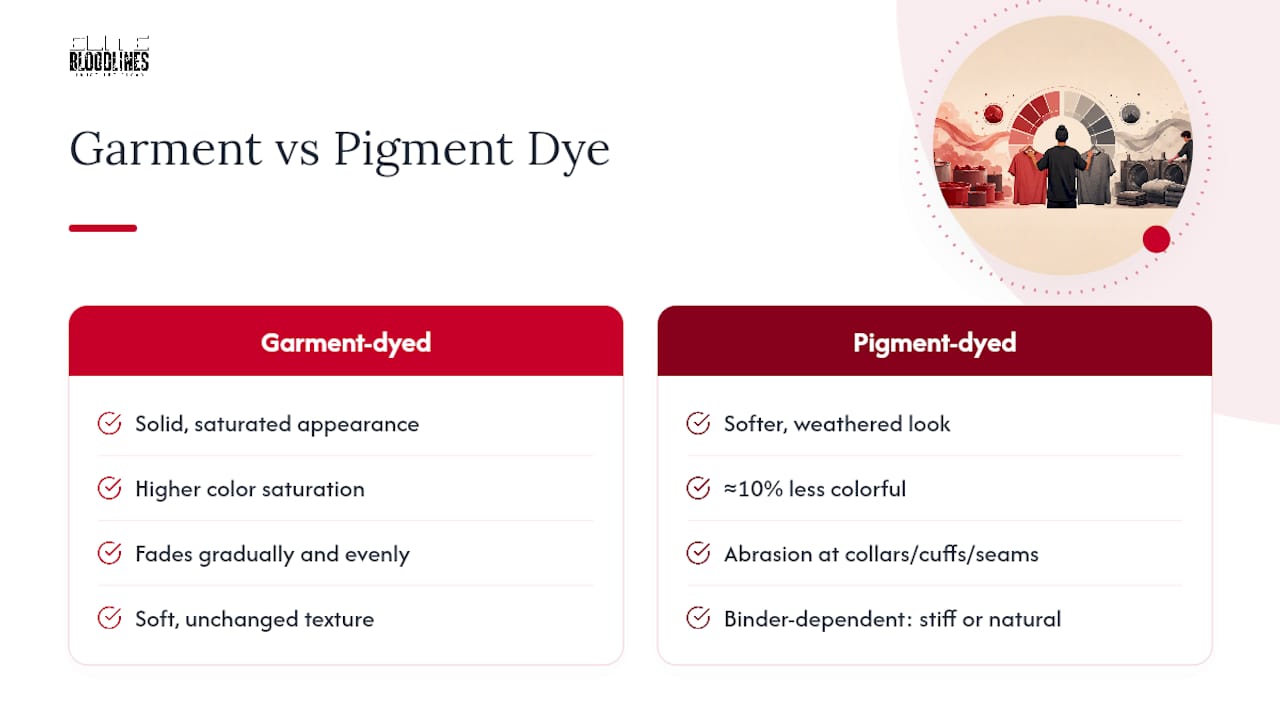
Garment-dyed pieces read as one solid, saturated color, inside and out, because the dye bonded with the fiber itself rather than sitting on top of it. Pigment-dyed pieces look noticeably softer and more weathered right off the rack. Perceptual testing shows pigment-dyed fabric registers as roughly 10% less colorful than the same shade applied through garment dye, which is exactly the muted, broken-in quality streetwear brands chase intentionally.
Wear tells the rest of the story. Garment-dyed fabric fades gradually and evenly as fiber-bonded color slowly breaks down under UV and washing. Pigment-dyed fabric wears differently: friction points like collars, cuffs, and seams start showing pigment abrasion, the surface coating literally rubbing off where fabric rubs against fabric or skin.
Hand feel separates the two just as clearly. Garment dye leaves fabric soft and unchanged in texture. Pigment dye’s hand depends entirely on binder quality. Cheap binders leave a stiff, almost crusty texture that only gets worse with wear; better binders and a cationic pre-treatment step keep the fabric closer to its natural drape.
What Production Managers Need to Know Before Committing to a Dye Method
Garment dye gives small brands a real edge: you can hold color decisions until late in production and dye finished garments in small batches without committing to a color month ahead. That flexibility comes at a cost, literally, since it requires stocking PFD blanks as raw inventory rather than pre-colored fabric.
Pigment dye is generally the cheaper, faster route per unit once binder and curing steps are dialed in, which is part of why it dominates budget-conscious vintage-wash lines. But it introduces its own quality-control headaches: uneven pigment strike across a batch, binder cracking under stress, and dye migration during printing.
Garment dye brings a different QC risk. Skip a thorough hot wash-off and unfixed dye stays trapped in the fabric, waiting to bleed the first time a customer runs it through the wash. Both processes reward brands that ask suppliers for a first-wash report before signing off on a run.
Printing on Garment-Dyed vs Pigment-Dyed Garments
Garment-dyed blanks make a more predictable printing substrate. Because the color lives inside the fiber rather than on top of it, there’s no surface coating competing with ink for adhesion, which is why garment-dyed pieces hold fine detail and discharge printing more reliably than pigment-dyed alternatives.
Pigment-dyed garments need more careful ink selection. The pigment and binder layer can bleed into standard plastisol ink during curing, so printers typically reach for low-bleed inks, poly-white bases, or dye-blocking primers to keep graphics crisp.
A short pre-production checklist saves a lot of reprints:
- Always test print on the actual finished garment, never a swatch.
- Use low-bleed or low-cure ink families on any pigment-dyed base.
- Confirm cure temperature won’t reactivate the garment’s own dye binder.
Pro Tip: If a pigment-dyed sample bleeds during your first test print, don’t just swap ink brands. Ask your dye house whether they’re skipping the cationic pre-treatment step. That’s usually the real culprit.
Washing and Care Rules for Each Dye Type
How a garment gets washed the first ten times matters more than most buyers realize.
- Check for a first-wash report from the manufacturer before selling garment-dyed stock. It confirms unfixed dye was cleared during hot wash-off.
- Wash garment-dyed pieces cold on a normal cycle. The color is bonded into the fiber, so it tolerates regular laundering well.
- Wash pigment-dyed pieces cold on a gentle cycle and skip high tumble-dry heat. Heat and friction are what abrade the binder layer and dull the vintage finish you paid for.
- If you spot dye transfer onto lighter fabrics, rinse the stained piece immediately in cold water. Don’t run it through a hot dryer, which sets the stain permanently.
How to Tell Which Dye Process a Garment Actually Used
A few seconds of inspection usually settles it. Turn the garment inside out: if the interior is exactly as saturated as the exterior, that’s garment dye at work, since the color bonded straight through the fiber rather than sitting on one face of it.
- Check seams and stitching. Pigment dye often leaves seam allowances slightly lighter since fabric folds shield them from the surface coating.
- Rub the fabric between your fingers. A stiff, slightly chalky texture points to pigment dye and a lower-grade binder.
- Read the product tag or spec sheet for the terms “garment-dyed,” “pigment-dyed,” or “PFD.” If none of that’s listed, ask the seller for a quick wash test before you commit to a bulk order.
Choosing Garment Dye or Pigment Dye for Your Next Design
Match the process to what the finished piece actually needs to do, not just what looks good on a mockup.
- Pick garment dye when you need consistent, saturated color across a full batch and you’re printing fine-detail or multi-color graphics that depend on a clean substrate.
- Pick pigment dye when the design calls for an immediate vintage or faded look and you’re working with tighter per-unit costs.
- Weigh how the piece will actually get used. Heavy-wear items like gym gear that see frequent washing hold up better in garment dye, while a lower-turnover fashion drop can lean into pigment dye’s patina without much downside.
Pro Tip: If you can’t decide, order both in small test runs and put them through 15 to 20 wash cycles before locking in your production order. The difference in how they age tells you more than any swatch ever will.
How Elite Bloodlines Chooses Between Garment Dye and Pigment Dye
Every collection starts with a question: does this design need color that holds its exact shade for years, or does it need to look like it’s already been through a hundred wears the day it ships? Heavyweight tees built for the gym typically get garment-dyed treatment for consistency under repeated washing. Vintage-inspired drops lean into pigment dye’s faded character on purpose.
Before any run gets approved, Elite Bloodlines checks three things: a finished-garment wash sample, a print adhesion test on the actual dyed fabric, and a binder-quality check on any pigment-dyed piece to rule out the stiff, crusty hand that ruins an otherwise solid design.
The Real Trade-Off Nobody Talks About Enough
Most guides frame this as a simple aesthetic choice: pick your look, pick your dye. That undersells the risk sitting on the production side. Garment dye’s biggest failure point isn’t the dyeing itself, it’s a rushed or skipped hot wash-off that leaves a customer with a bleeding shirt after one wash. Pigment dye’s biggest failure point isn’t the vintage look, it’s a cheap binder that turns “lived-in” into “falling apart” within a season.
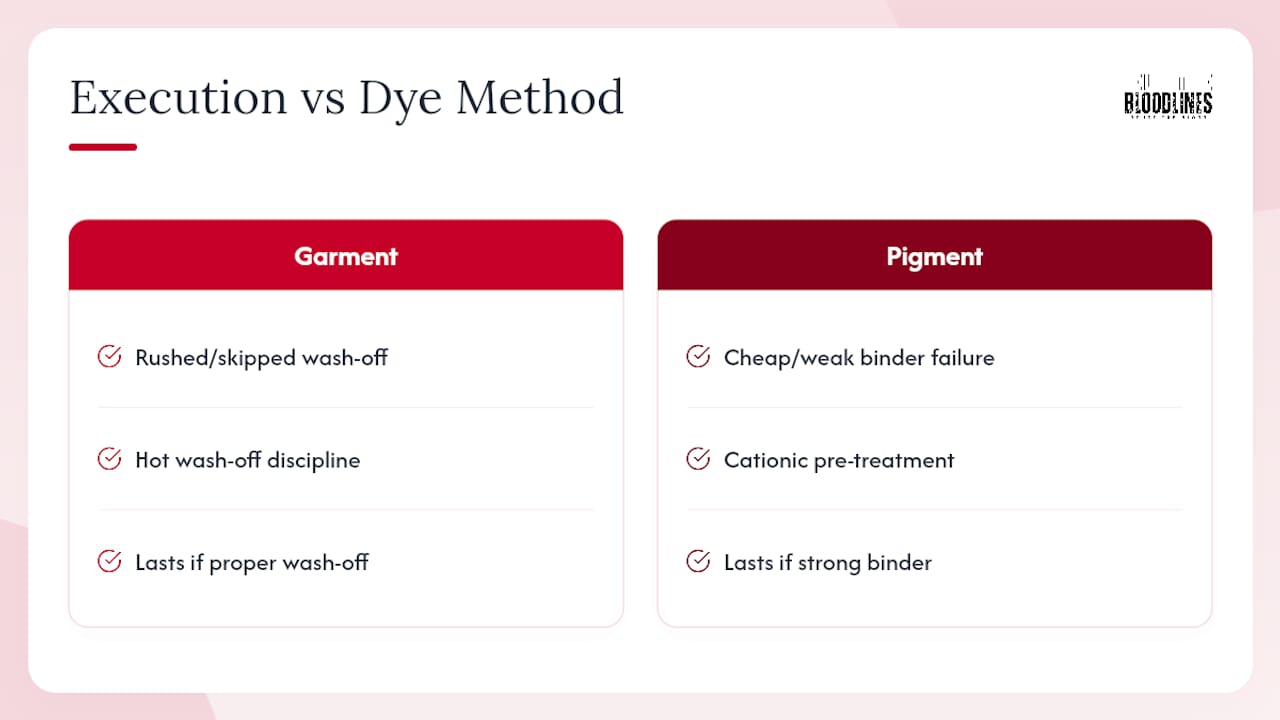
If you’re a small brand or a design-focused buyer, prioritize the supplier’s process discipline over the dye method itself. A well-executed pigment dye with a proper cationic pre-treatment will outlast a sloppy garment dye every time, and vice versa. The technique gets all the attention because it’s easy to explain. The execution, the fixation window, the wash-off, the binder grade, is what actually determines whether the garment you’re holding in six months still looks like the one you bought.
That’s the gap between what most buying guides tell you and what actually separates a piece that lasts from one that doesn’t.
— Michael
Shop the Look: Garment-Dyed and Pigment-Dyed Pieces Done Right
If you’re drawn to that faded, worked-in aesthetic this article just walked through, the EB Vintage Line is built around exactly that finish, with binder quality checked before any piece leaves production. If consistent, saturated color and sharp graphics matter more for your build, the EB Graphic Tees collection runs on garment-dyed heavyweight cotton designed to hold its shade through heavy training and heavy washing alike.

Whichever finish fits your design goals, the standard stays the same: no shortcuts on wash-off, no cheap binders, no compromises on the fabric that carries the graphic. Browse the EB Core Line Oversized Tee for a garment-dyed staple built to hold color drop after drop, or check what’s dropping next in Current Drops before the run sells out.
Sources
- What Are Pigment & Garment Dyed Garments? — Threadbird
- Screenprinting
- Garment dyeing of cotton apparel (technical bulletin) — Cotton Incorporated