

Lift Heavier, Wear Streetwear: 4 Leg Day Outfits for Men
The ideal leg day outfit men should build around is simple: a compression base layer, squat-proof shorts or fitted joggers on top, a fitted moisture-wicking shirt, and flat or dedicated lifting shoes. Swap shorts for leggings if you want more coverage, swap flat shoes for heeled lifters if your ankles are stiff, and keep accessories minimal. Everything below explains why each piece earns its spot.
TL;DR:
- Flat or dedicated lifting shoes are essential for heavy squats, providing stability and proper force transfer, while cross-trainers suit lighter or mixed sessions.
- Compression tights or liners prevent ride-up during deep squats and improve circulation, but they run hotter and reveal more leg details, so choose based on comfort.
- Oversized shirts can interfere with form and safety during lifts, so layering fitted tops underneath loose outer layers helps maintain visibility and movement.
- Tops should end above the hips to prevent bunching, and moisture-wicking, stretchy fabrics with reinforced seams and gussets ensure durability during intense training.
- Accessories like lifting belts, knee sleeves, and chalk enhance performance and comfort by supporting core stability, joint warmth, and grip, especially on maximum-effort lifts.
Table of Contents
- What Should You Wear on Leg Day? 4 Outfits That Work
- How Do You Choose the Right Bottoms for Leg Day?
- Do Oversized Shirts Interfere With Squats and Lunges?
- Which Shoes Actually Help You Lift More on Leg Day?
- What Fabric and Construction Details Matter Most?
- How Do You Add Streetwear Style Without Losing Function?
- Michael’s 6-Point Leg Day Outfit Checklist
- What Accessories Actually Help on Leg Day?
- Shop Elite Bloodlines Leg-Day Essentials
- Why Style and Function Belong in the Same Outfit
- Sources
- FAQ
What Should You Wear on Leg Day? 4 Outfits That Work
Not every leg day looks the same, so your outfit shouldn’t either. A max-effort squat session and a burpee-heavy conditioning circuit demand different gear, even though both fall under “leg day.” Here are four combinations built around what you’re actually training.
-
Heavy Squat Day. Compression tights or a compression liner, 7 inch squat-proof shorts over the top, a fitted heavyweight tee, and flat lifting shoes with a hard sole. The compression layer keeps everything locked down through a deep squat, and the flat sole gives you a stable base to drive through instead of sinking into foam.
-
Hypertrophy / Volume Day. Fitted joggers with four-way stretch, a snug tank top, and cushioned cross-trainers. You’re doing more reps at moderate loads across leg extensions, lunges, and hip thrusts, so you want fabric that moves with you set after set without bunching.
-
Plyometric or HIIT Leg Circuit. Compression shorts, a moisture-wicking fitted tee, and cross-training shoes with a slightly more forgiving sole. Jump squats and lateral bounds need lateral support that a flat lifting shoe doesn’t give you.
-
Recovery or Mobility Day. Loose joggers over a compression base layer, an oversized tee, and flat training shoes. Nothing is loaded heavy, so this is where you can lean into comfort and let the streetwear side of your closet take over.
For the squat day fit, try pairing a heavyweight graphic tee with fitted compression shorts underneath your squat shorts. The graphic tee gives the outfit a distinct edge without touching your range of motion, since it sits loose through the torso and never comes near your legs.
Each of these works because the bottom half stays tight enough to monitor and support your movement while the top half gets to carry your personality. That split is the whole formula.
How Do You Choose the Right Bottoms for Leg Day?
Shorts, leggings, and joggers each solve a different problem, and picking the wrong one is the most common leg day outfit mistake.
Shorts give you the most airflow and the clearest visual on your knee tracking, which matters when you’re checking depth and alignment in a mirror. The tradeoff is coverage. Loose shorts can ride up during a deep squat or a wide-stance deadlift setup, which is why most guys pair them with a liner.
Leggings or compression tights give full coverage and zero ride-up risk, but they run hotter and show every line of your legs, for better or worse. If you’re self-conscious about that, layer shorts over them.
Joggers sit in the middle. Good ones taper at the ankle and use stretch fabric through the thigh, giving you shorts-level mobility with legging-level coverage. They’re also the easiest to dress up with a streetwear top.
For inseam length, practical leg day guides recommend 5 to 7 inches for men, which balances coverage against the freedom to squat past parallel without fabric bunching at the hip crease. Anything shorter tends to expose too much on a deep lunge; anything longer starts restricting knee drive.
Squat-proof construction comes down to a few build details: a thicker knit that doesn’t go see-through when stretched, a gusseted crotch panel that gives without pulling, and a waistband that sits flat instead of rolling. Our squat-proof legging test breaks down exactly what separates a durable pair from one that gives out by week three.
Compression liners solve the biggest complaint men have about loose shorts: the mid-squat exposure problem. A liner underneath adds light compression that some editorial testing links to better circulation and reduced post-workout soreness, on top of just keeping things covered. If you’ve ever caught your reflection mid-set and realized your shorts rode up past where you’d like, a liner fixes that permanently.
Before you buy anything, run this test in the fitting room or at home:
- Drop into a full-depth squat facing a mirror and check for see-through fabric or seam strain.
- Step into a forward lunge and a side hip hinge to catch any ride-up at the waist or pinching at the seams.
- Do 5 to 10 bodyweight squats in a row to confirm the waistband stays put instead of rolling down.
Pro Tip: If you can’t tell whether a fabric goes see-through under stretch, hold it up to a bright light and pull it taut with both hands. If light passes through easily, it’ll show more than you want under gym lighting.
Do Oversized Shirts Interfere With Squats and Lunges?
They can, and that’s the main reason serious lifters lean toward fitted or semi-fitted tops on leg day. A baggy shirt can block your view of your own knee alignment in a mirror, and loose fabric around the collar or sleeves has a habit of snagging on a barbell during front squats or hip thrusts. Neither is dangerous exactly, but both are distractions you don’t need mid-set.
That doesn’t mean oversized tees are off the table. It means they need a job that isn’t interfering with your lift.
- Layer a fitted base tee or tank underneath a looser outer shirt so your form stays visible even if the outer layer moves.
- Make sure any oversized top ends at or above the hip so it doesn’t bunch when you bend at the waist.
- Choose lighter cotton or blended fabric for the outer layer so it doesn’t trap heat once you’re a few sets in.
- Roll or push up long sleeves before barbell work, especially for front squats where the bar rests near your collarbone.
For front squats and hip thrusts specifically, short sleeves or a sleeveless fit remove one more thing to think about. Your arms are doing real work stabilizing the bar or bracing against the floor, and a tight cuff catching on your elbow at the wrong moment is an easy way to lose your rack position. If you want tops built with this in mind, our best gym shirts for men roundup covers fitted options in breathable, heavyweight cotton blends that hold their shape through a full session.
Which Shoes Actually Help You Lift More on Leg Day?
Flat, firm-soled shoes are the right call for most heavy squat and deadlift work because they keep your foot stable against the floor instead of sinking into cushioning. Nike’s own training guidance backs this up, pointing out that stable trainers suit lifting while cushioned running shoes are built for a different job entirely: absorbing impact on pavement, not transferring force through a squat.
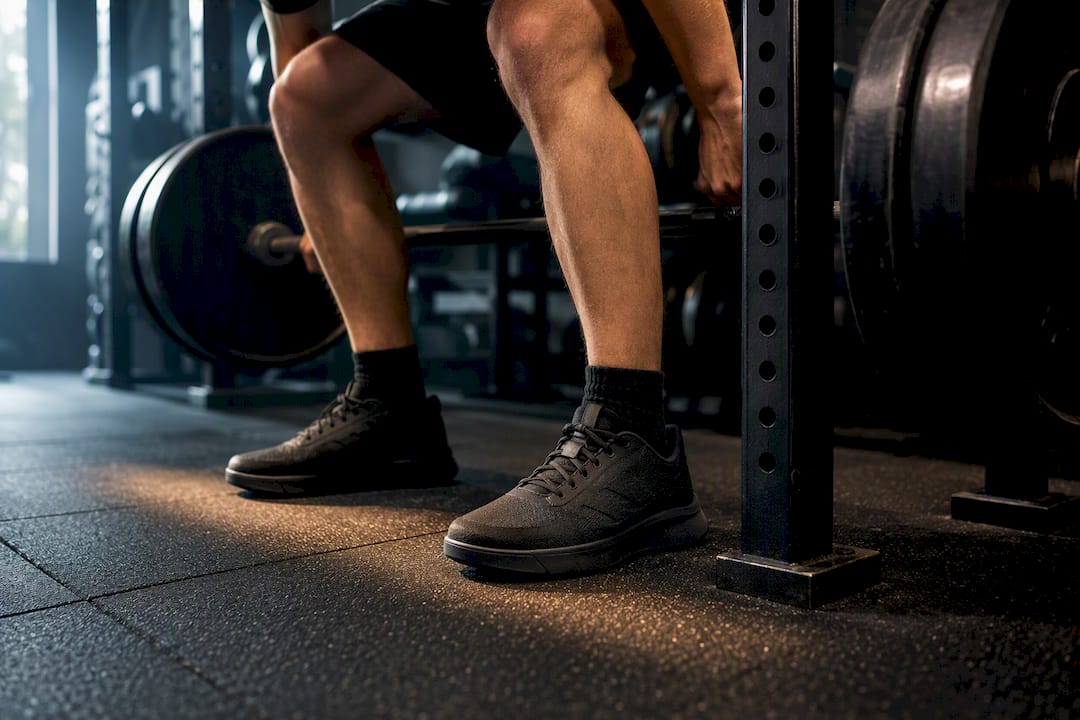
If you struggle to hit depth because your ankles feel locked up, a heeled lifting shoe changes the geometry in your favor. The raised heel lets your shin angle forward without your heel lifting off the ground, which can improve squat depth and torso posture.
Running shoes are the one thing you want to leave in the closet on heavy days. Their midsoles are built to compress and absorb shock, which means the ground feels less stable under a loaded bar. Editorial testing from fitness gear reviewers consistently steers lifters toward flatter, firmer options for exactly this reason, reserving max-cushion shoes for cardio days.
For mixed sessions that combine lifting with lunges, box jumps, or lateral movement, a cross-trainer with moderate cushioning and a wider base gives you a workable middle ground. You lose a bit of the stability a flat shoe offers, but you gain lateral support a flat lifting shoe doesn’t have.
Run through this before you buy:
- Press your thumb into the midsole. If it compresses easily, skip it for heavy lifting.
- Check heel height. Zero drop favors deadlifts; a raised heel favors squat depth.
- Look for a wide, flat base rather than a narrow, curved one.
- Match the shoe to the session, not the outfit.
Editors and trainers who test workout gear for a living consistently recommend picking shoes by workout type rather than by look, since a mismatched sole can cost you both stability and depth on your heaviest lifts.
What Fabric and Construction Details Matter Most?
Fabric is where a good leg day outfit quietly separates from a bad one, usually before you even notice it’s happening.
- Prioritize four-way stretch nylon-spandex blends. They move in every direction with your body instead of just up and down, which matters the moment you drop into a deep squat or a lateral lunge. Fitness editors testing gym apparel point to moisture-wicking, stretch-heavy fabrics as the baseline for anything you plan to squat or sprint in.
- Check the seams before you check the price tag. Reinforced, flat-lock seams sit closer to the body and resist blowing out under repeated squats, where a cheap seam will fray or pop within a few months.
- Look for a gusseted crotch, a wide non-roll waistband, and a small liner pocket. These three details separate gear that survives a real training block from gear that looks fine folded on a shelf.
Run the same three-part fit test here that applies to bottoms generally: full squat for opacity, lunge and hip hinge for ride-up, and a short set of reps for waistband stability. If a pair fails any of the three, it’s not a leg day pair, no matter how good it looks standing still.
Pro Tip: Wash performance fabric in cold water and skip the dryer’s high heat setting. Heat breaks down spandex fibers over time, which is why a $60 legging can lose its stretch faster than it should.
How Do You Add Streetwear Style Without Losing Function?
A neutral base with one accent piece reads as intentional instead of thrown together. Black compression shorts and a gray tee are a blank canvas; a bold graphic top or a contrast-colored jogger on top of that base is the one piece that makes the outfit yours. Trying to make every piece loud at once just looks busy under gym lighting.
Texture works the same way color does. Pair a matte compression bottom with a heavyweight cotton graphic tee on top, and you get visual contrast without sacrificing fit anywhere that matters. The rule for layering an oversized top over fitted bottoms is to keep the silhouette contrast clear: loose enough on top to read as streetwear, tight enough on the bottom to still show your form and stay out of your way.
For warm-up and cool-down, a lightweight zip hoodie over your base layer keeps you warm between sets without adding bulk once you strip it off for your working sets. Small accessories carry real weight here too:
- Calf-length socks keep shins clean during barbell work and add a clean line under joggers.
- A lifting belt used for its actual job, bracing on heavy sets, doubles as a style anchor once it’s cinched.
- A headband or wristband adds a streetwear detail without touching your range of motion anywhere.
One combination that leans hard into this: fitted black compression tights, an oversized heavyweight graphic tee that hits right at the hip, and a lifting belt cinched at the waist. It reads as deliberate, and it moves exactly the way a heavy squat session needs it to. Browse more of this pairing logic in our gym streetwear guide.
Michael’s 6-Point Leg Day Outfit Checklist
Every outfit recommendation in this guide traces back to one short checklist. Before you leave the house, run through it:
- Movement test. Squat, lunge, and hinge in the outfit before you trust it under load.
- Inseam check. 5 to 7 inches for shorts, tapered fit for joggers.
- Liner decision. Wearing loose shorts? Add a compression liner underneath.
- Top fit. Fitted or fitted-under-oversized, never fully loose near a barbell.
- Shoe check. Flat or heeled lifting shoes for heavy work, cross-trainers for mixed sessions.
- Final mirror test. Stand sideways and check that nothing bunches, rides up, or blocks your view of your own form.
Some streetwear pieces are built around this same checklist. Heavyweight graphic tees can hit at the hip so they never interfere with a hip hinge, and fitted shorts can pass the squat and opacity test before they enter a collection. Limited-run collections often mean the fit details get real attention instead of getting mass-produced into mediocrity.
What Accessories Actually Help on Leg Day?
The right accessories on leg day aren’t about looking finished. They’re tools that change how your body performs under load, and a few of them are worth owning even if you only lift heavy once or twice a week.
A weightlifting belt braces your core during max-effort squats and deadlifts, giving you something to push against as you build intra-abdominal pressure. It’s not something you wear all session. Save it for your top working sets, then take it off for accessory work where you want your core doing the bracing on its own.
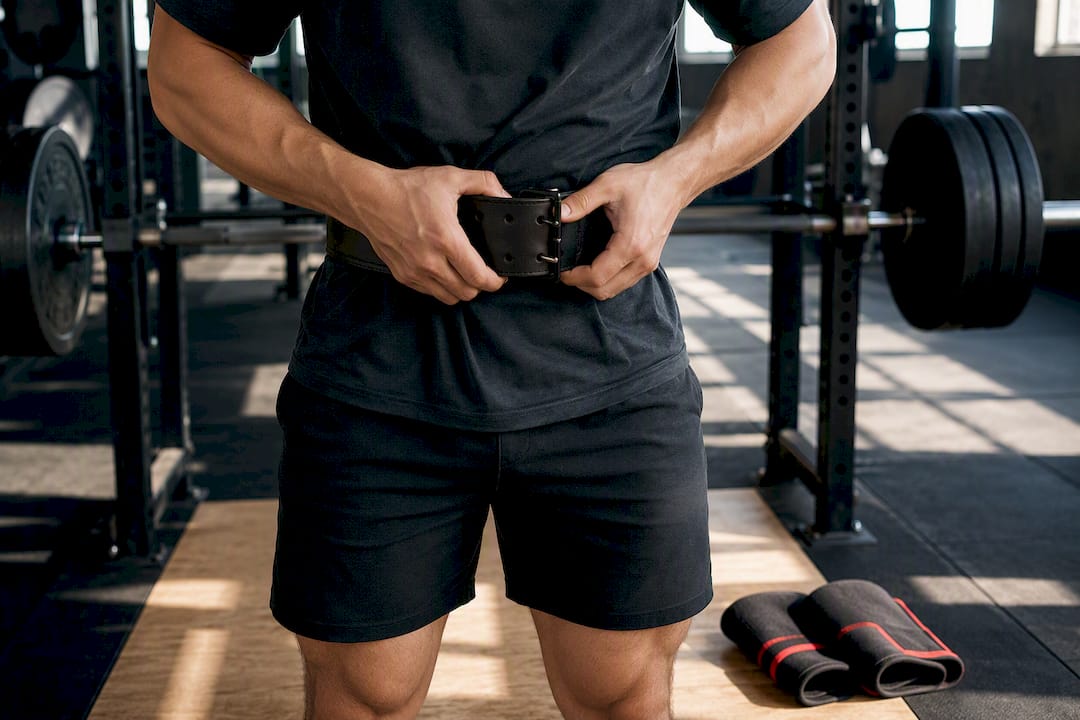
Knee sleeves add warmth and light compression around the joint, which some lifters find helps with comfort and confidence in the bottom of a deep squat, especially in colder gyms or on higher-rep days. They’re not a substitute for proper warm-up, but they’re a reasonable addition once your knees are already warmed up.
Wrist wraps matter less on leg day directly, but they show up during front squats where wrist position under the bar can get uncomfortable fast.
Calf-length socks protect your shins during barbell back rack positioning and add a clean finish under joggers or shorts.
Chalk or lifting gloves help grip during trap bar deadlifts or Romanian deadlift variations that are common on leg day. None of these replace good outfit choices. They layer on top of a fit that already passes the movement test.
Shop Elite Bloodlines Leg-Day Essentials
Elite Bloodlines is built for exactly the outfit formula this guide lays out: fitted pieces that pass the squat test, and top layers that give you a streetwear edge without touching your range of motion. Our EB Graphic Tees collection is heavyweight cotton cut to sit right at the hip, so an oversized silhouette never interferes with a hip hinge or a barbell front rack.
If you want something closer to a classic fit for everyday training, the EB Heritage Collection gives you a fitted tee that works equally well under a hoodie or on its own. And if you’re chasing the exclusivity angle, our Current Drops rotate limited-run designs that won’t be restocked once they’re gone, which is the whole point if you want gear nobody else at your gym is wearing. Check the current drops before this rotation sells out, or browse the EB Graphic Tees collection to build your leg day fit around a top that actually earns its spot.
Why Style and Function Belong in the Same Outfit
Confidence in the gym isn’t about blending in, and it never has been. The guys who look like they don’t care what they’re wearing are usually the ones overthinking it the most. Test your outfit choices against the checklist in this guide, not against what looks good standing still in a mirror before your first warm-up set. If it passes the squat test and still looks like you, wear it. That’s the whole standard.
— Michael
Sources
- The Best Workout Clothes for Men, Tested by Fitness Editors and Trainers
- What to Wear for Leg Day: Complete Gym Gear Guide
FAQ
How Should You Dress for Leg Day?
Wear a compression base layer under squat-proof shorts, joggers, or leggings, pair it with a fitted moisture-wicking top, and choose flat or dedicated lifting shoes over cushioned running shoes.
What Is the 3-3-3 Rule for Clothes?
The 3-3-3 rule is a minimalist wardrobe approach (3 tops, 3 bottoms, 3 pairs of shoes for a set period) and isn’t a leg day specific standard. For training, the more useful rule is matching your bottoms and shoes to the actual session rather than sticking to a fixed rotation.
Why Do Guys Avoid Leg Day?
Many lifters avoid leg day because it’s physically harder and the soreness lasts longer than upper-body sessions, but wearing gear that actually supports your squat depth and stability, rather than fighting it, makes the session easier to commit to.
What Are Gen Z Guys Wearing to the Gym?
Younger lifters are leaning into streetwear-influenced gym fits: heavyweight graphic tees, fitted compression bottoms, and layered pieces from limited-run drops rather than plain performance basics.
Are Leggings or Shorts Better for Leg Day?
Leggings give full coverage with zero ride-up risk, while shorts offer better airflow and a clearer view of your knee tracking; wearing a compression liner under loose shorts gets you the benefits of both.