

2–4 Inch Shoulder Drop: Oversized vs Regular Fit with GSM Cues
Oversized means the pattern is graded bigger on purpose, with a dropped shoulder and extra ease built into the cut; regular means the seams follow your actual body, with the shoulder seam sitting on the shoulder bone. Reach for oversized when you want a streetwear silhouette or a canvas for bold graphics. Reach for regular when you want a clean, classic line that reads sharp under a jacket or on its own.
TL;DR:
- Sizing up a regular tee does not create the true oversized look because a regular fit scaled up retains shoulder position and proportion issues.
- Genuine oversized garments feature shoulder drops of two to four inches and use heavier fabric to maintain shape, unlike simply buying a larger size.
- Fit labels vary across brands; product measurements and construction details are the only reliable indicators of the intended silhouette.
- Heavier fabric weights (180 to 240+ GSM) are essential for oversized pieces to hold their shape and properly display graphics or structure.
- Style balance requires pairing oversized tops with fitted bottoms and emphasizing proportions like length or tuck techniques, based on the fit type.
Table of Contents
- Oversized vs Regular Fit: What Actually Separates Them
- Why a Dropped Shoulder Changes Everything
- How to Choose Your Size for Each Fit
- Styling Oversized vs Regular: Outfit Rules That Work
- Does Fabric Weight Change How Oversized Fits Look?
- Which Fit Works Best for Your Body Type?
- Common Sizing Mistakes and an 8-Point Pre-Buy Checklist
- Elite Bloodlines’ Approach to Fit
- From Baggy Rebellion to Runway Standard
- Oversized vs Regular Across Shirts, Jackets, and Pants
- Caring for Oversized and Regular Garments
- My Take: Build a Small, Deliberate Fit Wardrobe
- Shop the Fits: Oversized and Regular, Built Right
- Sources
Oversized vs Regular Fit: What Actually Separates Them
The difference isn’t vague. It’s measurable, and once you know what to look for, you’ll never misjudge a fit again from a product photo.
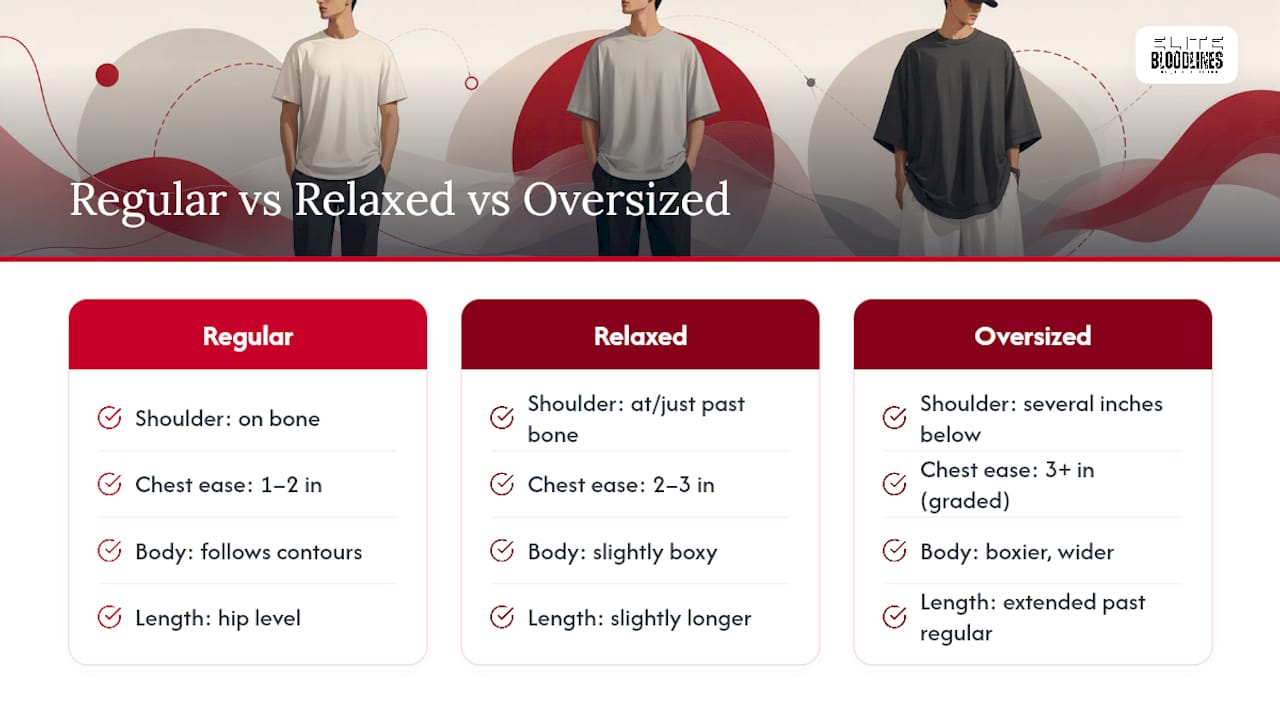
Regular fit follows the body’s natural contours. The shoulder seam sits directly on the shoulder bone, chest ease runs about 1 to 2 inches beyond your actual chest measurement, and the hem lands around hip level. This is the fit most people grew up calling “normal.” It’s the baseline every other fit gets measured against.
Relaxed fit sits in the middle. Chest ease expands to roughly 2 to 3 inches, and the shoulder seam drifts near the bone or just past it. Relaxed reads as understated rather than deliberate; it’s the fit you grab when you want breathing room without a statement. H&M’s own product guidance draws this exact line, describing relaxed as versatile enough for daily wear while treating oversized as the fashion-forward choice.
Oversized fit is graded larger across every single measurement, not just the chest. The shoulder seam drops several inches below the natural shoulder line, the body panel widens into a boxier shape, and length gets extended past where a regular tee would stop. This isn’t a “size up” trick. It’s a different pattern built from the ground up, with the dropped shoulder as its signature move. According to The Litt’s breakdown of oversized versus relaxed versus regular fits, the grading affects the entire garment, not one panel.
Here’s the trap: fit type describes how a garment is cut, not what size label it carries. A medium slim and a medium oversized share a size tag but sit completely differently on your frame. YourSizer’s fit guide makes this distinction explicit, and it’s the single biggest reason shoppers get burned buying “oversized” pieces online. The size chart tells you the numbers; the fit type tells you the shape those numbers are wrapped around.
One more wrinkle: “regular” isn’t standardized across brands. A regular fit at one label can run roomier than a relaxed fit at another. Product measurements, not fit labels, are the only reliable signal.
Why a Dropped Shoulder Changes Everything
Sizing up a regular tee and buying a true oversized cut are not the same move, even when the chest measurement lands close. The reason comes down to a concept called ease.
Ease is the gap between your body measurement and the garment’s actual dimension. A regular tee with 1 to 2 inches of ease sits close to your frame. An oversized tee is designed with intentional excess ease baked into the pattern from the start, not tacked on by grabbing a bigger number. Ease, as defined in garment construction), is the mechanism that separates a fit that drapes correctly from one that just looks baggy in the wrong places.
Here’s what changes when you size up a regular garment instead of buying true oversized:
- The neck opening stretches wider than intended, since the whole pattern scales up uniformly rather than shifting the shoulder seam and body panel independently.
- The shoulder seam doesn’t drop where it should. On a regular tee sized up, the seam still sits closer to the bone; it just has more fabric hanging off it.
- Sleeves get longer and looser at the exact wrong angle, often draping past the elbow in a way that looks accidental rather than styled.
- The hem falls unevenly, extending length without the width-to-length ratio an oversized pattern is designed to hit.
A true oversized cut solves all four issues at once because the pattern grader accounted for them. Check the shoulder drop yourself: lay the tee flat, measure from the actual seam to where your shoulder bone would sit, and if that gap is under an inch, you’re looking at a sized-up regular, not genuine oversized. Two to four inches of drop is the range that signals intentional design.
How to Choose Your Size for Each Fit
Getting this right on a product page takes about thirty seconds once you know what to check. Skip these steps and you’re gambling on a return.
- Read the product page for model height and the size they’re wearing. A 6’2" model in a size large tells you far more than a size chart alone.
- Check the actual chest, shoulder, and length measurements, not just S/M/L labels, since those vary between brands.
- Look for the language that signals intentional cut, like “drop shoulder,” “boxy,” or “relaxed through the body.” Brand blogs and product descriptions often flag these terms directly so shoppers know what they’re getting before checkout.
- Note the fabric weight (GSM) listed, since heavier fabric holds an oversized shape while lighter fabric collapses into looser drape.
- Test at home with a tee you already own and like. Lay it flat, measure chest width and length, then compare those numbers to the product page before buying.
- Confirm the return policy before you commit, especially on limited drops where a wrong-size purchase can’t just be swapped for the next batch.
The EB Humble Hustler loose drop shoulder tee is a solid reference point if you want to physically see a dropped shoulder before ordering something else in a similar cut.
Styling Oversized vs Regular: Outfit Rules That Work
Both fits reward the same core principle: balance volume with something tighter somewhere else on the body. Ignore that rule and even a well-made oversized piece reads sloppy instead of intentional.
Oversized styling rules:
- Pair the loose top with fitted or slim bottoms. A boxy tee over baggy joggers erases your silhouette entirely.
- Treat the oversized piece as your outermost layer whenever possible. It’s built to be seen as the statement, not buried under a jacket.
- Let the extra chest and back real estate carry the graphic. Large prints read better on a flat, untapered panel than on a fitted shirt where the design curves with the body.
- Use length as your anchor. A longer oversized hem paired with cropped or rolled bottoms creates proportion instead of just bulk.
Regular fit styling rules:
- A tuck or half-tuck defines your waist and keeps a regular tee from looking flat and shapeless.
- Regular fits layer cleanly under structured jackets and blazers since there’s no excess fabric bunching at the shoulder.
- Pair with slim or tapered trousers to keep the whole outfit reading intentional rather than accidental.
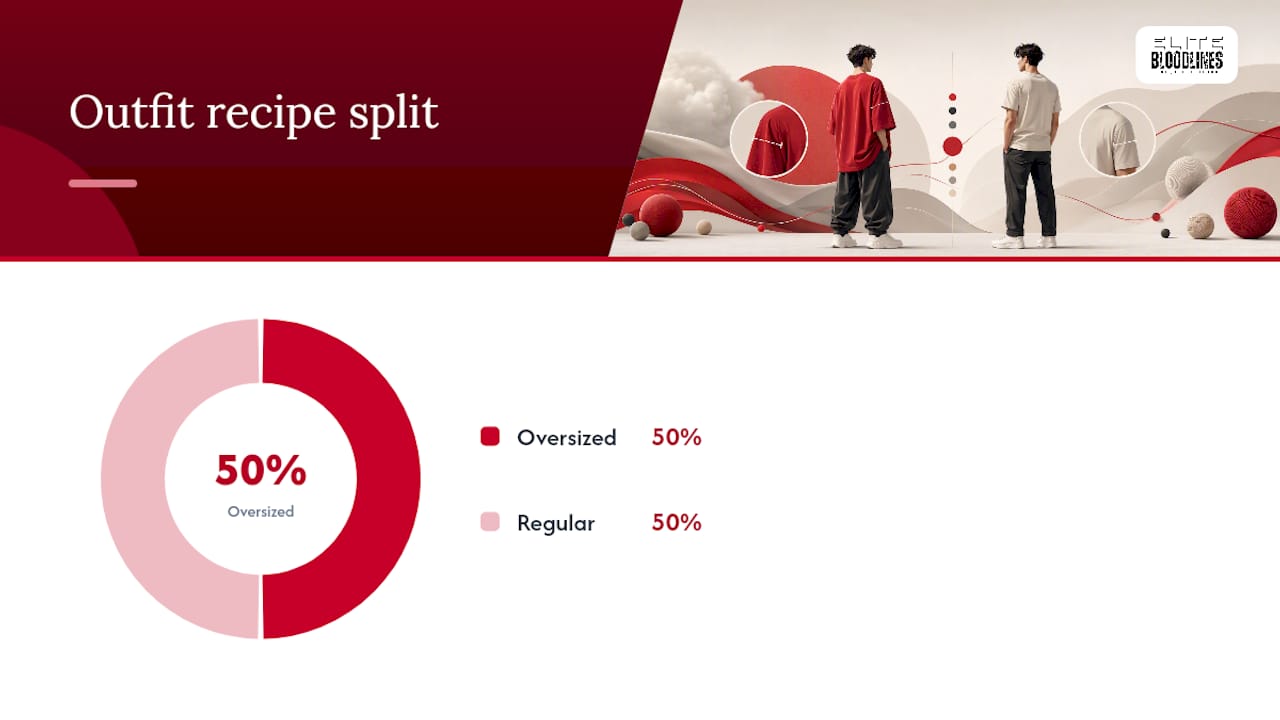
Four outfit recipes to steal directly:
Oversized, streetwear lean: Heavyweight graphic tee, tapered joggers, chunky sneakers, and a cap pulled low. The tee does all the talking.
Oversized, elevated lean: Drop-shoulder tee tucked into wide-leg trousers with a single front tuck, paired with clean minimal sneakers.
Regular, classic lean: Fitted tee tucked into straight denim, layered under an open flannel, finished with boots.
Regular, sharp lean: Regular fit tee under a structured overshirt, slim chinos, and a low sneaker for a look that works from daytime into evening.
Pro Tip: If you’re mixing an oversized top with fitted bottoms and the outfit still feels off, check your shoe silhouette. Chunky, wide sneakers balance oversized volume up top far better than sleek, narrow ones.
For deeper outfit breakdowns, Jeeyodee’s streetwear styling guide covers proportion balancing in more depth, and this graphic tee outfit roundup has ten ready-to-copy looks if you want more starting points.
Does Fabric Weight Change How Oversized Fits Look?
Yes, dramatically. Fabric weight, measured in GSM (grams per square meter), determines whether an oversized cut holds its shape or just hangs like a sheet.
- Oversized pieces generally need 180 to 240+ GSM to hold structure. Heavier GSM helps oversized garments maintain their silhouette instead of collapsing into a limp, shapeless drape.
- Regular fits work fine at 160 to 180 GSM, since the closer-to-body cut doesn’t rely on fabric structure to define the silhouette.
- Blends and weave type matter as much as weight. A tight-knit heavyweight cotton drapes with clean, sharp edges, while a loose or thin knit at the same nominal weight can still look flimsy.
The practical difference is visible at a glance. A 220 GSM oversized tee holds a crisp shoulder line and squares off at the hem, giving graphics a flat, poster-like canvas. A 150 GSM oversized tee in the same pattern will droop at the shoulder seam and cling oddly at the sides, undercutting the boxy look you paid for. If you want the oversized silhouette to actually read as designed rather than just “big,” heavier fabric isn’t optional. Compare weight ranges directly in this heavyweight versus regular tee breakdown before you buy.
Which Fit Works Best for Your Body Type?
Fit rules aren’t one-size-fits-all advice, and your proportions change what “balanced” actually looks like.
Petite frames generally do better in regular fits or women-specific oversized cuts designed with shorter body lengths in mind. If you love the oversized look anyway, shorten the effective hem with a front tuck or a half-tuck to keep the proportion from swallowing your frame.
Taller frames can wear oversized with almost no adjustment, since extra length and drop just read as intentional rather than excessive. The one thing to watch is sleeve length: a drop shoulder built for average height can end up hitting mid-forearm on a taller frame, which throws off the whole line.
Broad shoulders and muscular builds often benefit from relaxed or oversized cuts simply for comfort, since a regular fit can pull tight across the back and chest. The trade-off is sleeve heft: an oversized sleeve on an already-broad frame can add visual bulk you don’t need, so a fit with a slightly tapered sleeve opening tends to look cleaner. The oversized gym shirt guide covers this trade-off in more detail for lifters specifically.
Whatever your build, sleeve length, hem length, and tuck technique are your three levers. Shortening any one of them tightens the silhouette without changing the shirt itself. For a broader look at how proportion and tailoring interact on bigger frames, this piece on fit for larger body types is worth a read, even though it’s written for suiting rather than streetwear.
Common Sizing Mistakes and an 8-Point Pre-Buy Checklist
The most expensive mistake in this whole category is assuming “size up” equals “oversized.” It doesn’t; a sized-up regular tee has the wrong shoulder seam position no matter how big you go. Close behind that: ignoring fabric weight entirely and buying on price alone, and skipping the model height and measurement info because the product photo looks good.
Run through this before you check out:
- Where does the shoulder seam sit relative to the shoulder bone?
- How many inches of chest ease does the garment carry?
- Does the length match your intended silhouette (cropped, hip, longer)?
- Where does the sleeve hit your arm?
- What’s the GSM, and does it match the structure you want?
- What height and size is the model wearing?
- What’s the return window if the fit is wrong?
- Are you layering this piece, or wearing it solo?
Elite Bloodlines’ Approach to Fit
Elite Bloodlines builds two distinct fit families rather than treating “oversized” as a single generic box. The Core Line runs boxier and heavier, with dropped shoulders engineered for streetwear silhouettes and graphics that need a flat, wide canvas. The Heritage Collection runs closer to the body, aimed at a cleaner, classic line for customers who want the brand’s grit without the extra volume.
Sizing guidance is simple: buy true-to-size on any Core Line oversized piece. The pattern already accounts for the drop and ease you want. For deeper technical context on this design philosophy, the oversized streetwear tee breakdown and the guide to oversized streetwear brands both go further into how the cuts are graded.
From Baggy Rebellion to Runway Standard
Oversized fit didn’t start as a fashion statement. Hip hop culture in the late 1980s and early 1990s popularized loose, dropped silhouettes partly out of practicality and partly as a visual rejection of buttoned-up mainstream style. Skate and surf culture ran parallel, favoring room to move over a tailored line.
Regular fit, by contrast, traces back further, rooted in tailoring traditions where a garment’s value was measured by how closely it followed the body. For most of the 20th century, “well dressed” meant “well fitted,” and looseness signaled a poor tailor, not a choice.
The pendulum swung hard toward oversized again in the 2010s and accelerated through the early 2020s as streetwear moved from subculture to luxury runway. Designers who once made their names on precise tailoring started releasing dropped-shoulder pieces at premium price points, which legitimized oversized as intentional design rather than sloppy fit.
By 2026, the two fits coexist as equally valid wardrobe categories instead of one being the “correct” choice and the other a trend. What’s changed is precision: today’s oversized pattern grading is far more deliberate than the loose-for-loose’s-sake looks of past decades, with brands engineering specific shoulder drop and ease measurements rather than just cutting everything bigger.
Oversized vs Regular Across Shirts, Jackets, and Pants
The fit gap plays out differently depending on the garment category, and treating every piece with the same rule leads to mismatched outfits.
Shirts and tees show the clearest contrast. Oversized tees rely almost entirely on shoulder drop and length for their silhouette, since there’s no structure like a collar or zipper to anchor the shape. This is why graphic tees lean oversized so often: the flat panel is the whole point.
Jackets behave differently because they already carry built-in structure from shoulder pads, collars, or zippers. An oversized jacket still needs a dropped shoulder, but the effect reads less extreme than an oversized tee at the same measurements, since jacket fabric is usually heavier and holds its own shape regardless of cut. A regular fit jacket, meanwhile, needs precise shoulder alignment to avoid pulling across the back when you move.
Pants rarely use the term “oversized” the same way tops do. Instead, the equivalent language is “relaxed” or “wide leg,” describing extra room through the thigh and leg rather than a dropped anchor point like a shoulder seam. Regular fit pants follow the leg’s natural taper, while relaxed and wide-leg cuts add room progressively from hip to hem. Pairing an oversized top with relaxed pants often overwhelms a silhouette entirely, which is why the styling rules earlier lean toward fitted bottoms under a loose top.
Caring for Oversized and Regular Garments
Care requirements shift slightly between the two fits, mostly because of the fabric weight difference rather than the cut itself.
Heavier GSM oversized pieces, especially those in the 200 GSM-plus range, hold up better to repeated washing but take longer to dry and can lose shape faster if machine-dried on high heat. Wash oversized heavyweight tees inside out on a cold or cool cycle, and air-dry or tumble on low when possible. High heat is the fastest way to shrink a dropped shoulder seam out of position, which quietly ruins the exact silhouette you paid for.
Regular fit pieces in lighter fabric are more forgiving on wash temperature but more prone to visible wear at stress points like the collar and underarms, since the fabric sits closer to the body and takes more direct friction. Rotate regular tees more frequently in your wardrobe rotation to spread out that wear.
Both fits benefit from washing similar weights together rather than mixing heavyweight oversized pieces with lightweight regular tees in the same load, since agitation and drying time needs differ enough to affect both garments’ shape over time.
My Take: Build a Small, Deliberate Fit Wardrobe
If you’re starting from scratch, I’d build around two regular pieces, two oversized pieces, and one relaxed fit as your buffer. That mix covers clean layering, bold streetwear statements, and an easy in-between option without overcommitting to one silhouette.
Treat regular fits as your staples and budget more for the heavier-GSM oversized pieces, since fabric weight is where oversized quality actually shows. Buy those less often, buy them better.
— Michael
Shop the Fits: Oversized and Regular, Built Right
Elite Bloodlines cuts its Core Line specifically to match the oversized guidance covered above, with dropped shoulders and heavier fabric that actually holds shape instead of just hanging loose. The EB Core Line Oversized Tee and the EB Core Line Oversized Heavyweight Tee both run true-to-size, so order your normal number and let the pattern do the work.
If a closer, classic line is what you’re after, the EB Heritage Collection V1 delivers the regular fit rules from this guide: shoulder seam on the bone, minimal ease, clean under a jacket. Bold graphics, premium fabric, and limited-run exclusivity run through both fit families. Browse the full range in EB Graphic Tees and pick the silhouette that matches the look you’re building.
Sources
- Oversized vs Relaxed vs Regular Fit: T-Shirt Guide (The Litt)
- Understanding Fit Types: Slim, Regular, Relaxed, Oversized (YourSizer)
- Relaxed fit vs. oversized (H&M example) — ApartStyle