

1–2mm Detail Loss? When To Use Puff Or Screen Print For Streetwear
Choose puff for bold, tactile accents on logos, type, and small-batch streetwear drops. Choose standard screen print for fine detail, halftones, or the lowest per-unit cost at scale. Puff wins on presence and hand-feel. Flat ink wins on precision and economics once your run size climbs.
TL;DR:
- Puff printing creates a bold, textured, foam-like design that works best for large, simple shapes and accents rather than fine detail or tight negative space.
- Achieving consistent loft requires precise control of additive ratio, mesh count, squeegee pressure, and careful testing before full production.
- Puff yields a premium tactile look suitable for small-batch drops, but it has higher per-unit costs and can mute colors or lose detail if not cured properly.
- Standard screen printing is more cost-effective and better for complex color gradients, halftones, and large-volume production of detailed images.
- The choice depends on the artwork complexity, run size, desired finish, and budget, with hybrid approaches available to combine both techniques effectively.
Table of Contents
- Puff Print vs Screen Print: What Puff Ink Actually Does
- How Puff Printing Actually Gets Made: Setup, Cure, and Testing
- Pros and Cons of Puff Printing
- What Is Standard Screen Printing, and When Does It Win?
- Screen Printing Process and Production Tips
- Pros and Cons of Standard Screen Printing
- How to Choose Between Puff and Screen Print
- Elite Bloodlines’ Testing and Care Guidance for Raised and Flat Prints
- Environmental Impact and Sustainability Considerations
- Author Perspective: Balancing Design and Production Needs
- See These Techniques on Finished Garments
- Sources
- FAQ
Puff Print vs Screen Print: What Puff Ink Actually Does
Puff ink is a plastisol formula mixed with a blowing agent that expands during cure, lifting the design off the fabric into a raised, foam-like texture. It swells outward as much as upward, which means fine details and gaps under roughly 1 to 2 millimeters risk closing up entirely as the ink cures, according to Apparelist’s guide to screen printing puff ink. That single fact drives almost every artwork decision that follows.
Bold shapes read best. Thick block letters, chunky logos, and simplified icons hold their loft without merging into a blob. Tight serifs, thin outlines, and small negative space between letters do not.
Where puff earns its keep:
- Bold logo marks where the raised texture becomes the focal point
- Typographic accents like a brand name across the chest
- Small-batch streetwear drops where a tactile, premium feel justifies a higher price point
- Print-on-demand raised transfers, including Puff DTF, which let smaller labels test a design without committing to factory minimums, per Printify’s puff print guide
Scale matters as much as line weight. A puff design at 8 inches wide behaves very differently than the same art shrunk to a 3-inch chest hit.
How Puff Printing Actually Gets Made: Setup, Cure, and Testing
Getting consistent loft is a chemistry and heat problem, not a guessing game. Here’s the sequence that keeps a puff print from cratering, collapsing, or coming out flat and lifeless.
- Choose your additive ratio. Practitioner guidance points to a moderate additive percentage for controlled lift, prioritizing repeatable results over chasing maximum height, according to Screen Printing Magazine.
- Pick mesh count and stencil thickness. Lower mesh counts and thicker stencils raise ink deposit, which is what actually creates loft, per the Avient Specialty Inks print technique guide.
- Set squeegee pressure. A firmer stroke with a slightly softer squeegee lays down a thicker, more even deposit than a fast, light pass.
- Flash before full cure. Puff underbases sometimes need extended dryer time, in the range of 45 to 60 seconds, to fully develop before the final cure locks the texture in place.
- Run test strikes. Print a handful of samples before the full run and check loft height and edge definition against your target.
Pro Tip: *Print three test strikes at slightly different additive percentages before committing to a production run.
Pros and Cons of Puff Printing
Puff earns its premium placement in a lineup for a reason, but it comes with real constraints designers need to plan around.
Advantages:
- Genuine 3D texture that photographs well and stands out on a rack
- Justifies a retail premium because it feels like more than ink
- Creates visual hierarchy on small chest hits or sleeve prints without needing extra colors
Trade-offs:
- Fine detail and tight negative space get lost as the ink expands
- Colors can mute slightly once the ink lofts, so proofing on the actual blank matters
- Requires more process control, and rushed cures risk puckering around the print edges
Durability isn’t a fixed trait of the technique itself. A correctly cured puff print, done with the right ink chemistry and full cure, holds up over normal wear, per Screen Printing Magazine. Undercure, not the puff additive, is usually what causes cracking.
What Is Standard Screen Printing, and When Does It Win?
Standard screen printing lays flat plastisol or water-based ink through a mesh screen, with each color requiring its own screen and separation. For anything with real color complexity, this is the format built for it.
It’s the better call for:
- Halftones and simulated process work, where gradients and photographic detail need dozens of dot sizes to render smoothly
- CMYK-style color blending that would look muddy or oversimplified in puff
- Long production runs, where per-unit cost drops sharply as screens and setup get amortized across hundreds or thousands of pieces
On dark garments, an underbase (usually a white or light gray base layer) goes down first so the top colors don’t get swallowed by the fabric color. Mesh selection follows a simple rule: higher mesh counts (like 156 to 200) preserve fine detail, while lower counts lay down more ink for opacity and coverage.
Screen Printing Process and Production Tips
Getting a clean multi-color screen print depends on decisions made before the first squeegee pass, not fixes made after.
- Match mesh to the job. Fine detail and small type need high mesh counts; solid color blocks and underbases need lower counts for full opacity.
- Register colors in the right order. Print darkest to lightest, or follow your underbase first, then build up detail colors wet-on-wet to save flash cycles.
- Flash strategically. Flash between colors only when needed. Skipping unnecessary flashes keeps the ink hand softer.
- Verify cure, not just time. Use a donut probe or fabric thermometer to confirm the ink actually reached full cure temperature, not just that it sat under the dryer long enough.
Pro Tip: A heavier ink deposit builds better opacity on dark shirts, but it also stiffens the hand. If a soft feel matters to your brand, push for a thinner deposit and accept slightly less opacity rather than overcompensating with extra ink.
Pros and Cons of Standard Screen Printing
Advantages:
- Highly repeatable across large runs once screens are set up correctly
- Handles fine detail, small type, and complex color separations that puff simply cannot
- Per-unit cost drops significantly as order volume increases
Disadvantages:
- The finished look is flat, without the tactile dimension puff provides
- Multi-color jobs take longer to set up, since each color needs its own screen and registration pass
- Heavy ink deposits for full opacity on dark garments can stiffen the fabric’s hand
How to Choose Between Puff and Screen Print
Run through this checklist before you brief a printer:
- How much fine detail does the artwork actually need?
- What’s the final print scale, and does it hold up at that size?
- What garment weight and fabric are you printing on?
- What’s your run size, and how does that change your per-unit cost?
- What’s your budget ceiling per piece?
- Does the finish need to match a specific brand positioning, premium versus everyday?
Puff tends to cost more per unit at small runs because of specialty ink and thicker deposits, while standard screen print often becomes the more economical choice as order volume grows, according to RealThread’s cost breakdown.
When you talk to a printer, ask directly:
- What mesh count and additive percentage will you use?
- What’s your flash and oven cure profile for this ink?
- Do you run test strikes before full production, and can I see one?
- What loft tolerance should I expect between the sample and the final run?
You don’t have to choose one method exclusively. A hybrid approach, puff for the logo with a flat overprint or underbase for supporting type, can deliver texture where it matters and clean detail everywhere else, using the same underbase-and-overprint logic covered in Screen Printing Magazine’s underbase guide.
Elite Bloodlines’ Testing and Care Guidance for Raised and Flat Prints
Before any full run, validate with small-batch samples, measure actual loft height against target, and check for color shift once the puff ink cures. It’s also worth reviewing wash-count expectations the way you would for dye testing on a small brand run.
- Wash prints inside out, in cold water
- Avoid bleach entirely
- Use moderate dryer heat, or air dry when possible
Elite Bloodlines built its 6 Step Washing Routine around exactly this logic, since inside-out cold washing and moderate heat reduce stress on the print, per Screen Printing Magazine. Ask your printer for their documented cure profile and any sample-wash data before you commit to a full production run.
Environmental Impact and Sustainability Considerations
Neither method is inherently cleaner than the other. What matters is ink chemistry, water use, and how much gets reprinted due to failed samples.
Plastisol, the base for both standard and puff inks, is PVC-based and doesn’t biodegrade easily, which is why more shops are shifting toward water-based and discharge inks for flat printing where the design allows it. Puff formulas are harder to reformulate this way because the blowing agent that creates loft depends on specific plastisol chemistry, so water-based puff alternatives remain less common and less consistent.
Water-based screen printing generally uses more water during screen reclaiming and cleanup, while plastisol systems use more solvent-based cleaners. Neither is a clear winner. The bigger sustainability lever is often production discipline rather than ink type: every failed test strike, every undercured print that cracks and gets returned, and every rushed run without proper sample validation adds fabric waste and wasted energy on top of the ink itself.
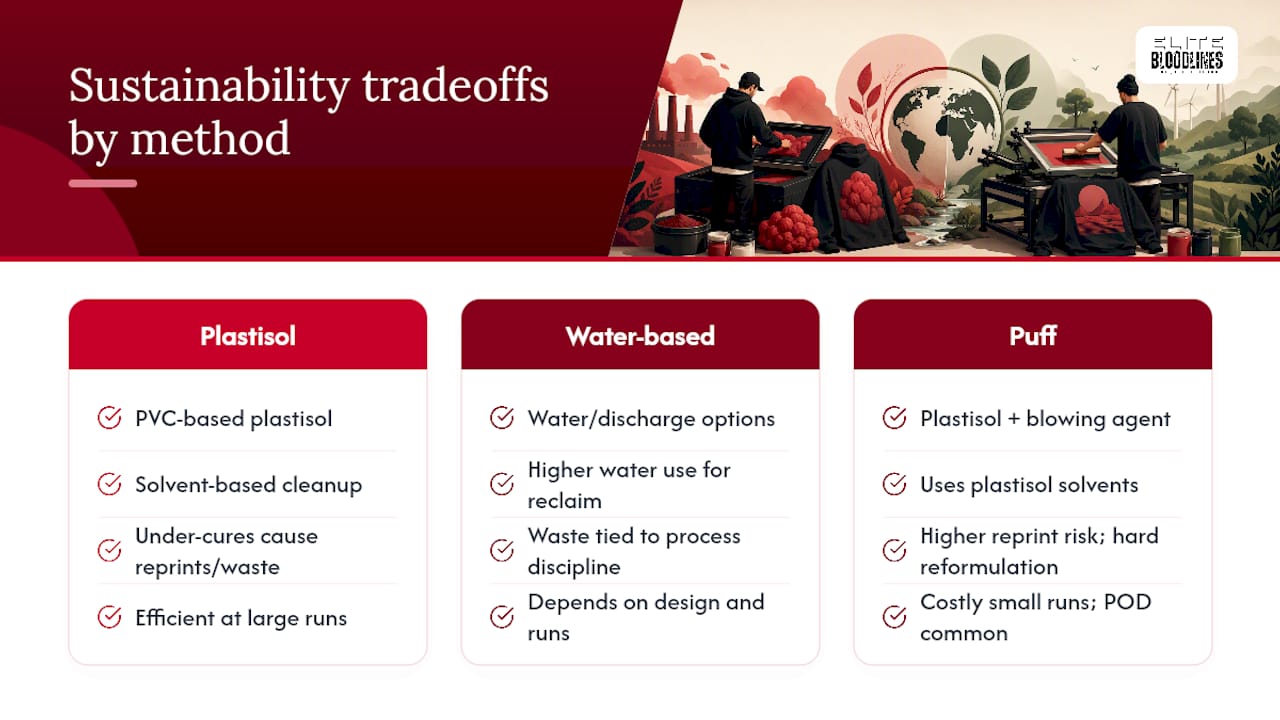
Run size also plays a role. Puff’s higher per-unit cost at small batches, as noted earlier, often pushes smaller brands toward print-on-demand puff transfers instead of full production runs, which can reduce overproduction and unsold inventory. For brands running larger volumes, standard screen printing’s efficiency at scale means less ink and energy spent per unit once screens are set up. The most sustainable choice, in practice, is usually the one that matches your actual run size and demand, not the flashiest technique on the mood board.
Author Perspective: Balancing Design and Production Needs
Repeatability beats maximum height every time production runs at scale. Treat your first sample as a prototype, not a promise, and negotiate loft tolerance with your printer before committing art to screens.
— Michael
See These Techniques on Finished Garments
Reading about loft height and mesh counts only gets you so far. Seeing how puff and flat ink actually sit on a heavyweight blank, at real scale, on real fabric, tells you more in ten seconds than another paragraph of specs.
Elite Bloodlines builds every drop around exactly the trade-offs this guide covers: bold, raised graphics on premium heavyweight cotton, run in limited batches so the print stays exclusive instead of mass-produced. If you want to see puff-style texture and high-impact flat graphics side by side on the same collection, the EB Graphic Tees line shows both approaches at production scale, and the EB Core Line shows how the same design choices read on a heavier blank. Check the current Current Drops to see what’s live now before it sells out.
Sources
- Adding Dimension: A Guide to Screen Printing Puff Ink - Apparelist
- An underbase with a punch - Screen Printing Magazine
- How much does puff print cost - RealThread blog
- Screen printing with puff ink - Screen Printing Magazine
FAQ
What Are the Disadvantages of Puff Print?
Puff print loses fine detail, since narrow gaps under roughly 1 to 2 millimeters close up as the ink expands during cure. It also costs more per unit at small runs and requires tighter process control to avoid cratering or muted colors.
Can You Screen Print Puff and Standard Ink Together?
Yes. Puff can be printed alongside flat inks in the same design using an underbase or overprint, with careful flash timing so each layer cures correctly, according to Screen Printing Magazine. This hybrid approach puts texture only where it counts.
Is Puff Print More Expensive Than Screen Print?
Usually, yes, at small run sizes. Puff requires specialty ink and thicker deposits, which raises per-unit cost, while standard screen print becomes more economical as your order volume grows, per RealThread.
Does Puff Print Crack Easily?
Not when cured correctly. Durability comes down to cure temperature, ink formulation, and substrate, and a properly cured puff print holds up well over normal wear, per Screen Printing Magazine. Cracking is almost always a sign of undercure, not a flaw in the puff technique itself.
Does Elite Bloodlines Use Puff Printing on Its Apparel?
Elite Bloodlines applies bold, raised graphic techniques across select drops in collections like EB Graphic Tees, built on heavyweight fabric designed to hold texture and detail. Current pricing and availability are listed directly on the collection page.